
www.technology4environment.com
20
'26
Written on Modified on
Industrial Green Hydrogen Rectifier Power Conversion
ABB launched its UNIREC H2 water-cooled thyristor rectifier, engineered to convert alternating current into high-current direct current for large-scale electrolysis plants.
global.abb
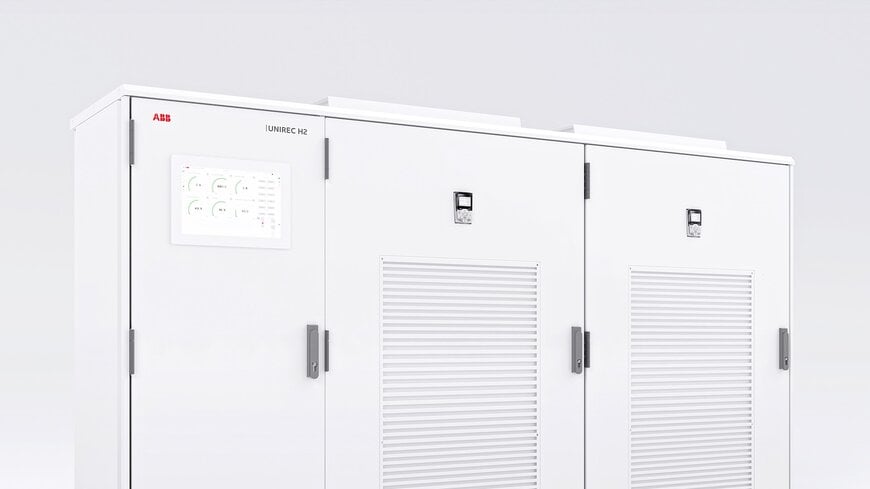
Electrolytic hydrogen generation relies heavily on high-voltage alternating current (AC) supplies from public grids or renewable sources, which must be converted into precisely controlled, low-voltage direct current (DC) to feed chemical cell stacks. Because electrical power inputs represent an estimated 60 to 70 percent of total operating expenditure in green hydrogen facilities, conversion losses at the power-supply interface directly dictate the levelized cost of hydrogen (LCOH).
Industrial Hydrogen Plant Electrification Challenges
Water electrolysis units, including proton exchange membrane (PEM) and alkaline systems, demand substantial continuous direct current to maintain continuous chemical splitting of water into hydrogen and oxygen. Scaling output from tens of megawatts to gigawatt-scale hydrogen plants exposes plant operators to severe financial penalties whenever conversion systems exhibit thermal or electrical dissipation. A fractional drop in power supply efficiency multiplies into thousands of megawatt-hours in parasitic losses across large-scale stacks annually.
In addition to baseline efficiency, electrical equipment deployed in heavy industrial hydrogen manufacturing must withstand continuous operation without premature component failure. Systems utilizing electrolytic capacitors often suffer from degradation caused by high operational temperatures and current ripple over extended runtimes. Consequently, operators require conversion platforms capable of providing bulk direct current while minimizing maintenance cycles and down-time.
Operating Principle of Multi-Pulse Thyristor Rectification
ABB has addressed these conversion bottlenecks with the UNIREC H2 power rectifier, a liquid-cooled multi-pulse thyristor system engineered to optimize power conversion efficiency in large-scale hydrogen production. Multi-pulse thyristor topologies control the conduction angles of solid-state switches across multiple phases, delivering uniform direct current to the electrolyzer while mitigating harmonic distortion fed back into the industrial power distribution network.
The unit achieves a power conversion efficiency of up to 99.6 percent at nominal operating current. Liquid cooling removes thermal energy directly from internal active semiconductors, allowing the enclosure to sustain continuous heavy-duty duty cycles within compact footprints. To enhance hardware reliability over multi-decade operating horizons, the electrical architecture omits common wear-prone components such as electrolytic capacitors.
Scalable Architecture and Output Capacity
Each UNIREC H2 unit delivers an output current of up to 6 kA and supplies up to 7.5 MW of continuous direct current. The system incorporates standardized modular power stacks that can be paralleled to support diverse electrolyzer configurations, scaling from discrete megawatt-range installations up to cluster topologies exceeding 1 GW.
“Electricity consumption is fundamental to the economics of green hydrogen and as hydrogen projects expand, customers need power solutions that combine high efficiency and reliability with scalable architecture,” said Sarah-Xiaolan Huang, Global Product Manager for UNIREC H2 at ABB Energy Industries. “UNIREC H2 is designed to help reduce energy losses while providing a reliable DC power platform for large-scale hydrogen production.”
Plant-Wide Power System Optimization
Power electronics inside green hydrogen facilities do not function in isolation from upstream grid interconnects or downstream stacks. Overall plant yield depends on comprehensive balance-of-plant design, including transformer matching, energy storage integration, harmonic compliance, and power quality management.
“UNIREC H2 is designed to reduce energy losses at the point of power conversion, but the opportunity goes beyond a single piece of equipment,” said Danilo Moresco, Global Business Line Manager, Power Reliability at ABB Energy Industries. “By looking at power architecture, controls and energy optimization across the plant, we can help operators make more effective use of every megawatt available.”
International Energy Agency tracking indicates global hydrogen demand surpassed 100 million tonnes in 2025, during which installed electrolysis capacity reached more than 4 GW and low-emissions hydrogen volumes expanded by 20 percent to nearly 1 million tonnes. Platforms targeted at plant-wide efficiency improvements remain essential for developers striving to achieve acceptable capital bankability on gigawatt-scale assets.
Additional Context
This section details technical specifications and competitive benchmarking not included in the original product announcement.
Electrolyzer power supplies typically employ either line-commutated thyristor (silicon-controlled rectifier) architectures or self-commutated active front end (AFE) topologies utilizing insulated-gate bipolar transistors (IGBTs). While IGBT-based converters offer adjustable power factors and low total harmonic distortion without passive harmonic filter banks, their full-load conversion efficiency generally hovers between 96 and 98 percent due to higher high-frequency semiconductor switching losses.
In contrast, line-commutated multi-pulse thyristor rectifiers switch synchronously at network line frequency, minimizing internal switching dissipation and enabling conversion efficiencies up to 99.6 percent. This operational characteristic makes high-current thyristor technology an industry standard for multi-megawatt chlor-alkali and metallurgical smelting systems, as well as gigawatt-scale hydrogen projects where ongoing operating expenses take priority over the reactive power management footprint of external harmonic filter networks.
Edited by Evgeny Churilov, Induportals Media - Adapted by AI.
www.abb.com
