
www.technology4environment.com
21
'26
Written on Modified on
Industrial Solar Photovoltaic Systems for Rail Rolling Stock Manufacturing
Alstom commissions a 1 MW solar park in Mátranovák to stabilize industrial electricity supply and reduce fabrication emissions.
www.alstom.com
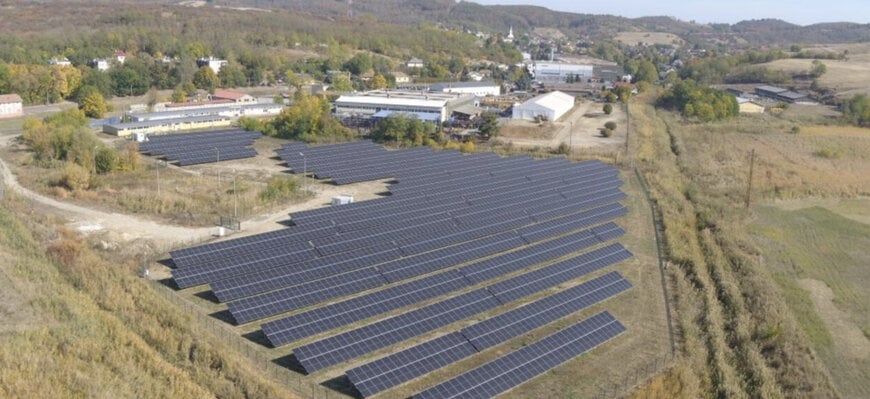
Heavy structural manufacturing for railway transport involves energy-intensive mechanical processing, including continuous multi-pass welding, high-temperature heat treatment, and precision plate cutting, making production facilities vulnerable to grid volatility and carbon-accounting penalties. To address these operational energy requirements and meet industrial decarbonization mandates, rail mobility manufacturer Alstom has commissioned a 1 megawatt (MW) ground-mounted solar park at its bogie fabrication facility in Mátranovák, Hungary, establishing dedicated onsite renewable energy generation.
Onsite Renewable Power Architecture and Operational Decarbonization
The solar installation occupies approximately 7,000 square meters of industrial land at the facility. Constructed through a long-term corporate Power Purchase Agreement (PPA) in partnership with energy utility E.ON, the development required nearly two years of site planning, grid permitting, and structural installation. Under the behind-the-meter PPA framework, the energy provider finances, builds, and maintains the photovoltaic array, while the manufacturing plant purchases the generated electricity at a contracted rate.
Engineering projections indicate the 1 MW photovoltaic array will yield approximately 1,700 megawatt-hours (MWh) of electricity annually. This volume covers more than 20 percent of the plant's total electrical power consumption. In operational terms, the onsite generation offsets grid-supplied power, avoiding an estimated 260 tonnes of carbon dioxide equivalent (CO2e) emissions annually. The installation functions alongside site-level energy efficiency upgrades implemented at the facility, such as solid-state LED industrial lighting conversions, administrative building insulation retrofits, and thermal heating plant modernizations.
Bogie Frame Manufacturing Workflows and Energy Resilience
The Mátranovák industrial complex represents a core fabrication node within European rail rolling stock supply chains, having manufactured safety-critical bogie frames for four decades. Bogie frames serve as the primary structural interface between wheelsets, suspension elements, braking units, and car bodies, demanding strict dimensional tolerances and certified welding integrity to resist dynamic dynamic track stresses.
Components fabricated at the Hungarian site supply diverse rail transport platforms across European networks, encompassing high-speed trains, urban metro units, commuter locomotives, suburban trainsets, and articulated double-decker passenger cars. Alstom maintains a broad operational footprint across Hungary, having supplied half of the metro train fleet operating on Budapest Metro Lines 2 and 4, while the state rail operator MÁV deploys 25 Traxx electric locomotives manufactured by the company alongside additional leased units.
Corporate Leadership on Manufacturing Resilience
The operational impact of decentralized energy generation was outlined by executive leadership following grid synchronization.
"By generating renewable electricity on site, we are strengthening the sustainability of our operations and supporting the long-term future of the plant and its manufacturing activities," said Gáspár Balázs, CEO of Alstom Hungary. "The project also provides access to a stable, predictable and competitively priced source of electricity, strengthening the resilience of our manufacturing activities."
Additional Context:
This section details technical specifications and competitive benchmarking not included in the original product announcement.
Heavy fabrication facilities producing rail bogie frames operate under high continuous electrical baseloads governed by fusion welding standards such as DIN EN 15085-2 CL1 and ISO 3834-2. Laser cutting machines, multi-axis plasma arc profiling units, pre-heating stations, and robotic arc-welding cells draw heavy intermittent currents that create inductive loads and peak-demand charges on regional medium-voltage distribution grids.
The Mátranovák installation's projected specific yield of approximately 1,700 kilowatt-hours per kilowatt-peak (kWh/kWp) exceeds standard fixed-tilt central European photovoltaic benchmarks, which typically generate between 1,100 and 1,250 kWh/kWp. This elevated efficiency indicates the deployment of high-performance bifacial photovoltaic modules, optimized ground-albedo configurations, or single-axis tracking systems designed to capture diffuse horizontal irradiance common to northern Hungary.
Across the European rolling stock sector, primary rolling stock manufacturers—including Siemens Mobility, Hitachi Rail, and Stadler Rail—are increasingly deploying behind-the-meter solar arrays to align heavy assembly sites with ISO 50001 energy management protocols and the European Union Corporate Sustainability Due Diligence Directive. Integrating decentralized solar arrays directly behind industrial utility meters mitigates exposure to transmission tariff spikes and hedges peak daytime operating costs during heavy production shifts.
Edited by Natania Lyngdoh, Induportals editor, with AI assistance.
www.alstom.com
