
www.technology4environment.com
16
'26
Written on Modified on
Green methanol vessel trials begin in dry bulk shipping
Cargill launches the dual-fuel vessel Brave Pioneer to test green methanol operations and carbon accounting in global dry bulk trade.
www.cargill.com
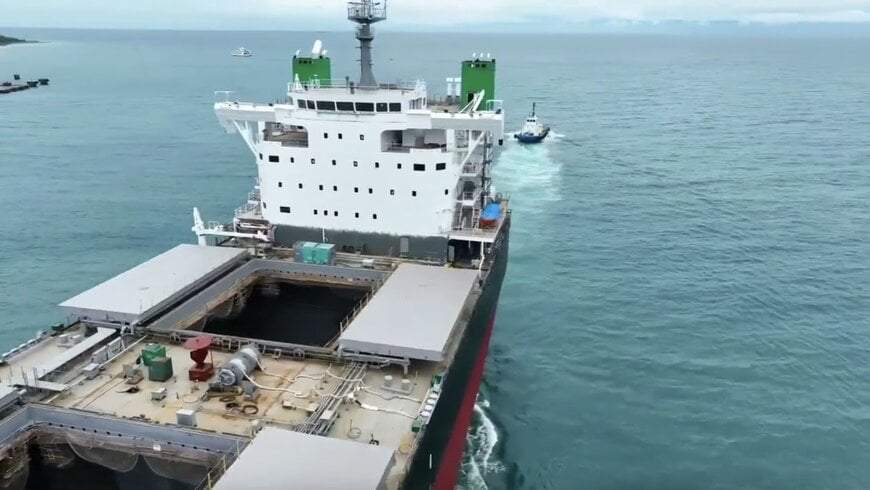
Cargill has started operational trials of green methanol in ocean freight with the maiden voyage of Brave Pioneer, a dual-fuel dry bulk vessel designed to operate on both conventional marine fuels and renewable methanol.
Green methanol as a decarbonization pathway
Maritime transport accounts for a significant share of global supply-chain emissions, and dry bulk shipping presents particular challenges due to long voyages and limited fuel infrastructure. Green methanol—produced from renewable feedstocks—offers a potential reduction of up to 70% in CO₂ emissions compared with conventional marine fuels, depending on production pathways and lifecycle assumptions.
By chartering methanol-ready vessels, Cargill is testing how this fuel performs in real operating conditions rather than pilot-scale demonstrations.
Vessel design and operational scope
Brave Pioneer was built by Tsuneishi Shipbuilding and is owned by Mitsui & Co.. The vessel is equipped with a dual-fuel propulsion system, allowing it to switch between conventional marine fuels and green methanol without compromising operational flexibility.
The voyage profile is designed to test end-to-end readiness: departure from the Philippines, green methanol bunkering in Singapore, followed by port calls in Western Australia and onward sailing to Europe. This routing enables evaluation of fuel handling, storage, and combustion across multiple regulatory and climatic environments.
What Cargill is testing
During the maiden voyage, Cargill is conducting structured trials focused on three technical areas. The first is bunkering readiness, assessing procedures, safety protocols, and time requirements for methanol fueling at a major hub. The second is environmental data integrity—tracking and verifying fuel attributes through carbon accounting systems to support credible emissions reporting. The third is market response, evaluating customer demand for lower-carbon freight services in dry bulk trades.
These trials are intended to generate operational data that can inform vessel design, fuel procurement strategies, and emissions verification frameworks.
Scaling toward a low-carbon fleet
Brave Pioneer is the first of five green methanol-capable dry bulk vessels chartered by Cargill. The remaining vessels are scheduled to enter service over the coming years, forming part of a broader decarbonization portfolio that also includes wind-assisted propulsion, voyage optimization, energy-efficiency retrofits, and alternative fuels such as biofuels and ethanol.
From a fleet strategy perspective, the vessels are engineered to deliver competitive performance on conventional fuel while preserving the option to transition to lower-carbon fuels as supply chains mature. This approach reflects current constraints in renewable fuel availability while avoiding stranded-asset risk.
Implications for dry bulk shipping
As one of the world’s largest charterers of dry bulk tonnage, Cargill’s move provides a demand signal to shipowners, fuel suppliers, and ports that green methanol is being actively evaluated at commercial scale. The operational data generated from these voyages is expected to contribute to emerging standards for alternative marine fuels and support broader adoption as infrastructure and regulation evolve.
In the near term, green methanol-ready vessels represent a transitional but technically viable step toward reducing emissions in global dry bulk logistics, particularly when paired with transparent carbon accounting and scalable fuel supply.
www.cargill.com
