
www.technology4environment.com
29
'26
Written on Modified on
CHINT integrates solar plant infrastructure and digital controls for Italian grid compliance
The 1 MW photovoltaic plant combines a prefabricated substation, power plant controller and cloud platform to meet Italian regulations and improve monitoring.
www.chintglobal.com
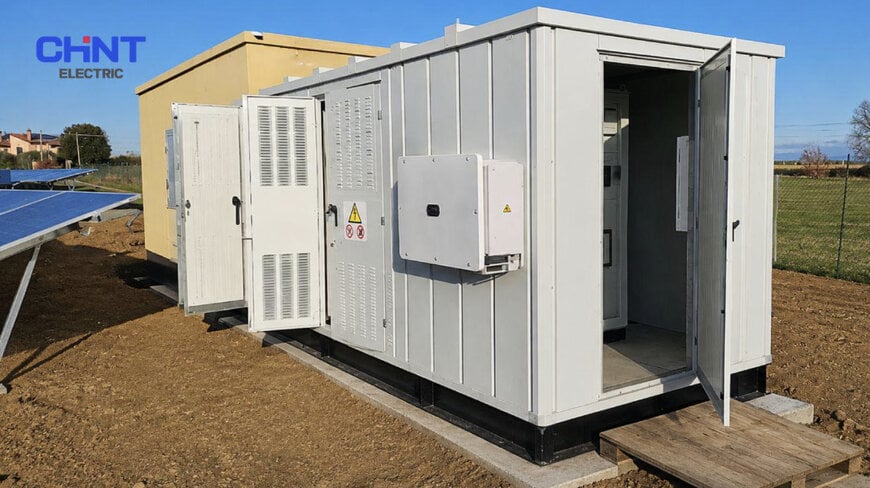
Stringent grid code compliance mandates require renewable energy operators to integrate automated power regulation and continuous tele-monitoring at the medium-voltage point of common coupling. To satisfy these interconnection rules, CHINT delivered a turn-key balance-of-system architecture comprising a prefabricated substation and a Power Plant Controller (PPC) equipped with Urbana Central Plant Controller (CCI) technology for a 1 MW utility-scale solar generation facility in Civita Castellana, Lazio, Italy.
Substation Integration and Point of Common Coupling Architecture
Utility-scale photovoltaic generation connected to distribution networks requires balance-of-plant electrical equipment capable of stepping up generated voltages while protecting upstream electrical assets against phase faults and frequency disturbances. Integrating disparate electrical enclosures often leads to extended civil works, complex cabling interconnections, and elevated commissioning risks on site.
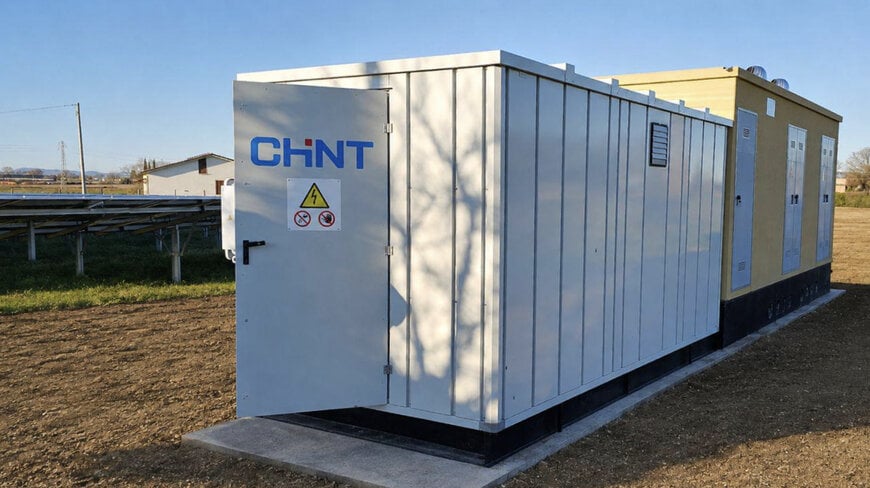
The Civita Castellana installation utilizes a CHINT shelter-type prefabricated substation configured for rapid field interconnection. The enclosed, factory-assembled shelter houses three core subsystems: low-voltage distribution boards that aggregate inverter feeder outputs, a step-up oil-immersed or dry-type power transformer that converts low-voltage generation up to distribution levels, and medium-voltage switchgear equipped with circuit breakers and protective relays.
By unifying switching, transformation, and metering within an environmentally protected housing, the system functions as a unified point of common coupling (PCC). This architecture protects sensitive switchgear from environmental ingress, reduces on-site wiring cycles, and ensures standard-compliant electrical clearance between low- and medium-voltage boundaries.
Power Plant Control and Real-Time Grid Code Automation
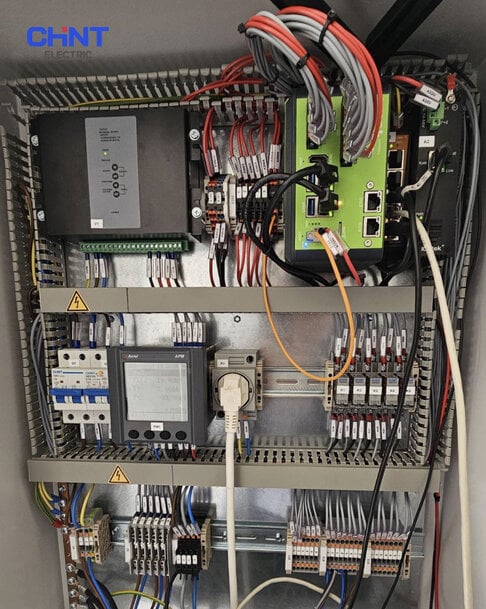
Medium-voltage renewable power plants must dynamically coordinate their active and reactive power profiles to prevent local grid overvoltage and maintain network frequency stability. Operating under Italy's CEI 0-16 technical standard and regulatory frameworks issued by the Italian Regulatory Authority for Energy, Networks and Environment (ARERA), the 1 MW plant relies on the CHINT Power Plant Controller integrated with Urbana CCI technology.
The PPC serves as the local telemetry and automation brain, executing automated closed-loop adjustments based on grid voltage, active power, and reactive power parameters. The unit collects metering signals directly from the substation instrument transformers and sends control commands to the solar inverters across fieldbus networks.
When distribution system operators signal a curtailment request or when voltage fluctuations occur at the busbar, the controller modulates inverter output within predefined millisecond response times. This closed-loop regulation prevents nuisance tripping of the main interface protection relay and maintains compliance with utility injection limits.
Digital Cloud Monitoring and Operations Optimization
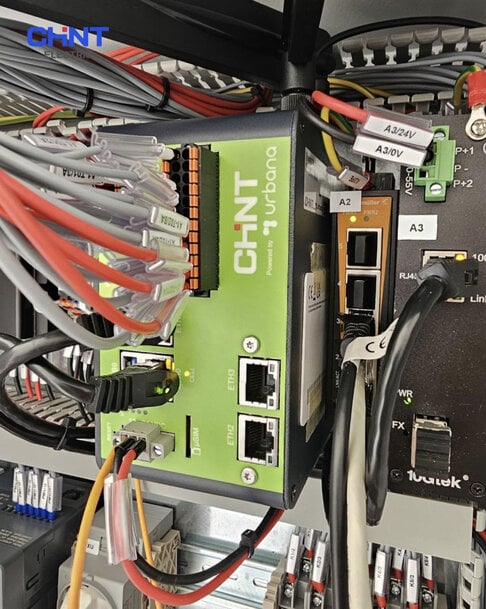
Beyond local electrical control, modern renewable installations require centralized visibility to reduce operational expenditure and accelerate fault resolution. The hardware footprint at the Civita Castellana site is linked directly to CHINT's cloud-based monitoring platform.
The system aggregates operational metrics from the medium-voltage switchgear, transformer temperature probes, and inverter strings. By maintaining continuous bi-directional communication, the cloud system delivers real-time asset dashboards, event logging, and alarm dispatching for plant operators. Maintenance teams can diagnose insulation faults, thermal anomalies in the transformer core, or string-level generation shortfalls remotely before dispatching field technicians, supporting plant uptime and predictable asset depreciation over the facility lifecycle.
Additional Context:
This section details technical specifications and competitive benchmarking not included in the original product announcement.
In Italy, medium-voltage grid integration is strictly regulated by the CEI 0-16 standard alongside ARERA Delibera 540/2021/R/eel and Delibera 385/2025/R/eel. These resolutions establish mandatory observability and controllability criteria for distributed generation installations with capacities equal to or greater than 1 MW. Central to this regulatory framework is the Controllore Centrale d'Impianto (CCI) defined in CEI 0-16 Annex O (functional logic) and Annex T (communication protocols).
The CCI device must communicate upstream with distribution system operators (such as E-Distribuzione) and the transmission system operator (Terna). Upstream data exchange utilizes the IEC 61850 protocol secured by Transport Layer Security (TLS) and Public Key Infrastructure (PKI) encryption over dedicated channels.
The controller must execute three defined functions: PF1 (real-time telemetry and plant observability with sampling rates of 4 seconds or faster), PF2 (active power limitation and curtailment commands via Rigedi procedures), and PF3 (reactive power and power factor regulation). Failure to deploy a fully certified CCI apparatus can prevent commercial grid connection or result in the suspension of operational feeding tariffs.
In the European utility-scale solar balance-of-plant market, CHINT's combined substation and PPC platform competes with offerings from established electrical engineering firms, including SMA Solar Technology (SMA Power Plant Manager), Ingeteam (Ingecon Sun PPC), Schneider Electric (EcoStruxure Grid / prefabricated kiosk substations), and ABB (Compact Secondary Substations).
Benchmark comparisons reflect differing integration models across these platforms:
- Control System Architecture: Dedicated automation providers like Ingeteam and SMA deliver high-speed Power Plant Controllers focused primarily on inverter-level dynamic regulation, often requiring third-party engineering contractors to procure, wire, and commission the external medium-voltage switchgear, transformer kiosks, and protection relays. In contrast, electrical equipment manufacturers like CHINT and Schneider Electric deliver prefabricated, packaged secondary substations that house the switchgear, protection equipment, and PPC/CCI controller within a single pre-tested enclosure, minimizing field engineering and interface liability.
- Cybersecurity and Protocol Stacks: Standard utility PPCs historically relied on open industrial protocols such as Modbus TCP or DNP3 to communicate with supervisory networks. The mandate for IEC 61850 MMS with certificate-based TLS authentication under CEI 0-16 Annex T requires ruggedized controllers featuring hardware cryptographic engines and secure boot architectures. The Urbana CCI platform integrated into CHINT's system provides these cryptographic layers natively, matching the specialized substation automation capabilities traditionally delivered by specialized transmission-tier automation suppliers like Tesmec or Siemens SIPROTEC.
