
www.technology4environment.com
27
'26
Written on Modified on
Green Hydrogen Plant Simulation Platform for Renewable Integration Optimization
Sener & Tekniker develop the SenHy digital platform to optimize green hydrogen production economics and balance intermittent renewable power.
www.sener-group.com
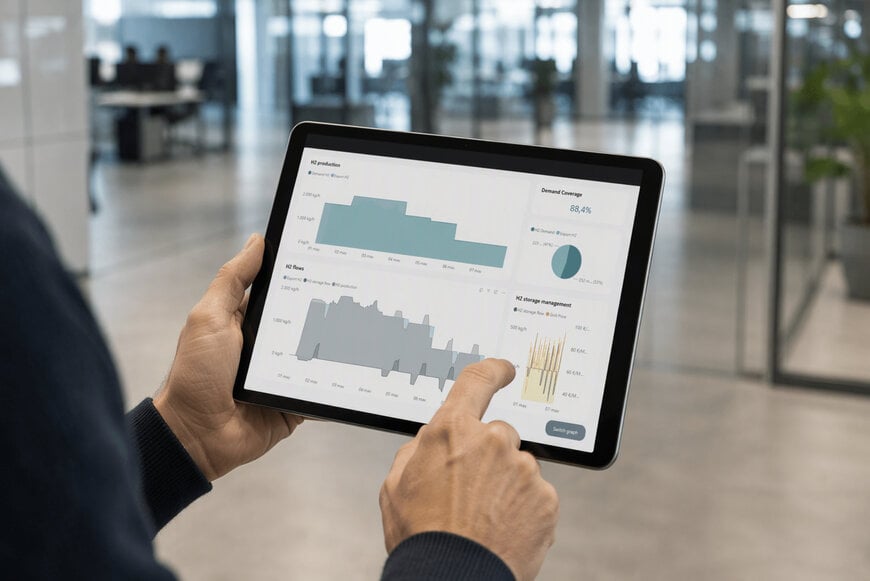
Engineering and technology firm Sener has collaborated with technology center Tekniker to develop SenHy, a specialized digital twin platform engineered to optimize the design, operating strategies, and economic performance of green hydrogen production plants. Developed within an Important Project of Common European Interest (IPCEI) framework, the initiative provides industrial operators and energy developers with modeling infrastructure to mitigate capital risk and lower the levelized cost of hydrogen.
Operational Challenges in Variable Renewable Electrolysis
Commercial green hydrogen production requires aligning variable, intermittent power generation from solar and wind assets with capital-intensive electrolysis equipment. Without coordinated controls and predictive modeling, fluctuating electrical inputs can degrade electrolyzer cell stacks, reduce overall plant efficiency, and inflate operating expenditures. Standard design tools often lack the multi-variable resolution needed to assess techno-economic trade-offs between electrolyzer sizing, electrical grid tie-ins, and dynamic operational profiles.
Technical Architecture and Engineering Division
SenHy operates as a digital twin that simulates plant dynamics by evaluating more than 200 interrelated parameters simultaneously. A core technical capability developed by the partnership is the platform's multi-technology modeling engine, which evaluates and combines Proton Exchange Membrane (PEM) and alkaline electrolysis within a unified hybrid facility.
Sener contributed its multiphysics optimization algorithm to model operational scenarios, capital expenditure structures, and operating strategies. Complementing this framework, Tekniker developed the platform's Power Management System (PMS). The PMS generates automated dispatch setpoints that adjust production rates according to renewable energy availability, ambient operational constraints, and power market dynamics. Sener unified these modules into a single digital platform that links pre-construction configuration with operational dispatch logic.
Industrial Implementation and Economic Parameters
Developed to advance European industrial decarbonization targets, the digital tool addresses both front-end engineering design and active asset management. By modeling interactions across the power-to-gas process chain, the platform identifies optimal equipment configurations that lower the levelized cost of hydrogen production and protect balance-of-plant components.
The resulting optimization balances asset utilization with degradation constraints, reducing operational uncertainty for utility-scale facilities. By integrating real-time automated dispatch controls with multiphysics system simulation, Sener and Tekniker provide industrial operators with a verifiable methodology to de-risk green hydrogen infrastructure investments.
Edited by Natania Lyngdoh, Induportals editor, with AI assistance.
www.group.sener.com
