
www.technology4environment.com
20
'26
Written on Modified on
Hydro Produces First Low-Carbon Aluminium via HalZero
Hydro achieves first metal production with HalZero technology to replace the Hall-Héroult process and eliminate direct smelting emissions.
www.hydro.com
Primary aluminium smelting has long relied on the Hall-Héroult electrochemical reduction process, which consumes carbon anodes to extract aluminum from alumina, generating direct process carbon dioxide emissions. In addition to direct reduction reactions, the upstream fabrication and continuous degradation of carbon anode blocks contribute substantially to the metal's lifecycle carbon footprint. Resolving these emissions requires an alternative metallurgical reduction route that decouples oxygen extraction from carbon consumption while maintaining stable chemical loops across all production phases.
Chlorination Refining and Closed-Loop Electrolysis
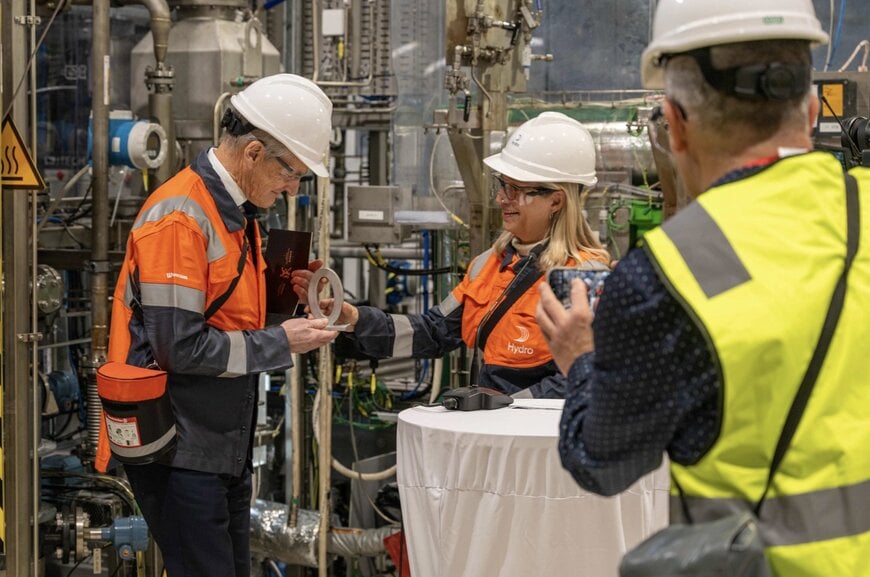
Hydro produced aluminium for the first time using its HalZero electrolysis technology, marking a proof-of-concept milestone for its proprietary primary smelting process. Developed in partnership with Norwegian research institutions NTNU and SINTEF since 2016, the HalZero architecture provides an alternative to the Hall-Héroult process patented in 1886.
The technology converts alumina into aluminum chloride prior to cell electrolysis. Within this reaction flowsheet, both chlorine and carbon operate inside closed chemical circuits. Instead of releasing carbon dioxide from consumed anode material, the fully scaled process is engineered to capture and recycle process gases internally, releasing elemental oxygen as the primary byproduct rather than carbon dioxide.
Test Facility Operations and Industrial Piloting Roadmap
The initial metal run was executed at Hydro’s dedicated technology test center situated on Herøya in Porsgrunn, Norway. The facility was established with 141 million Norwegian kroner in funding from state enterprise Enova in 2023 and entered continuous operation in January 2026 to validate individual chemical conversion stages.
Current testing at Porsgrunn isolates the core HalZero stages, where transitional carbon dioxide emissions remain present. The development roadmap focuses next on an integrated industrial concept pilot designed to evaluate all steps simultaneously—chlorination, intermediate gas purification, molten salt electrolysis, and loop recycling. This concept pilot will establish engineering, thermodynamic, and process kinetics baselines before moving to commercial scale. Development resources combine corporate investment with allocations from the climate and energy mechanism under Norway’s CO2 compensation scheme.
According to Hydro President and CEO Eivind Kallevik, the milestone validates the fundamental chemistry developed alongside NTNU and SINTEF, providing the baseline for multi-year testing toward industrial-scale, zero-emission primary smelting.
Additional Context
This section details technical specifications and competitive benchmarking not included in the original product announcement.
This section details technical specifications and competitive benchmarking not included in the original product announcement.
In standard Hall-Héroult smelting, the carbothermic reduction of alumina dissolved in a molten cryolite bath (Na3AlF6) operates at approximately 960°C. The consumable carbon anode reacts directly with oxygen, releasing roughly 1.5 to 2.0 metric tons of direct CO2 per metric ton of liquid aluminium produced, excluding indirect electrical generation emissions. By transitioning to a chloride-based electrolyte (typically a mixture of aluminum chloride, sodium chloride, and lithium chloride), operating temperatures decrease to roughly 700°C to 750°C. This lower thermal window reduces specific energy consumption, potentially dropping cell energy requirements from 13–14 kWh/kg to roughly 9.5–11 kWh/kg of aluminium.
Within the emerging zero-carbon smelting landscape, HalZero benchmarks directly against inert anode initiatives, most notably the Elysis joint venture backed by Alcoa and Rio Tinto. The Elysis pathway maintains a fluoride bath while replacing carbon anodes with proprietary non-consumable cermet or metallic anodes that emit oxygen directly. However, inert anodes face thermodynamic overpotentials, requiring a higher cell voltage that can increase overall electrical consumption by 10 to 15 percent unless offset by advanced cell design. In contrast, while the HalZero chloride route operates at lower cell voltages, it requires comprehensive process containment to prevent the leakage of hazardous chlorine gas and avoid the formation of organochlorine side products during chlorination, establishing material corrosion resistance and total chlorine recycling as the critical engineering benchmarks for industrial deployment.
