
www.technology4environment.com
19
'26
Written on Modified on
Industrial Hydrogen Liquefaction Plant Engineering
Kawasaki Heavy Industries and Japan Suiso Energy deploy cryogenic liquefier systems to establish large-scale energy infrastructure for industrial maritime transport.
www.kawasakirobotics.com
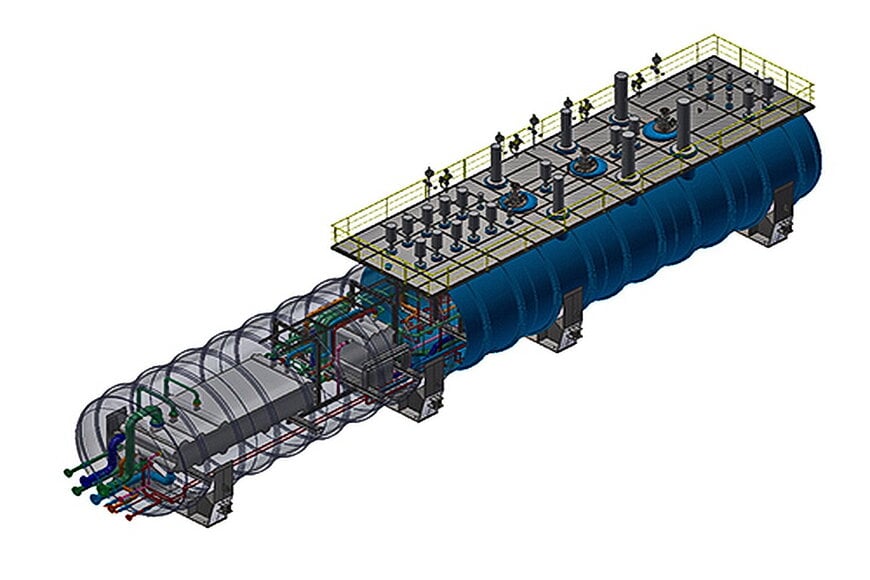
Kawasaki Heavy Industries and Japan Suiso Energy have begun construction of an industrial hydrogen liquefaction plant at the Kawasaki LH2 Terminal in Kanagawa to support large-scale energy transport infrastructure. The project establishes commercial-scale cryogenic processing facilities capable of supplying liquefied hydrogen for power generation, heavy transport, and process industries.
Industrial Challenge and Operational Context
Transporting gaseous hydrogen across intercontinental distances requires significant volume reduction to remain economically and operationally feasible. Cooling hydrogen to -253°C reduces its volume to approximately 1/800 of its gaseous state, allowing dense cargo loading in specialized marine transport vessels and cryogenic storage terminals.
Establishing this energy infrastructure requires high-capacity regional terminals capable of continuous cryogenic phase changes. Kawasaki Heavy Industries serves as the engineering and manufacturing provider for the core liquefier, while Japan Suiso Energy operates as the terminal developer integrating the facility into the commercial supply chain demonstration supported by the New Energy and Industrial Technology Development Organization (NEDO).
Technical Solution and Engineering Architecture
The facility relies on a specialized hydrogen liquefier engineered to achieve continuous cryogenic operation. The system integrates advanced heat exchangers, expansion turbines, specialized cryogenic valves, and insulated transfer piping. Maintaining thermodynamic stability at -253°C requires high thermal insulation performance to minimize boil-off losses and parasitic heat ingress.
To scale up equipment dimensions, engineers combined vacuum insulation methods with high-speed rotating machinery derived from industrial gas turbine and aerospace turbine development. The aerodynamic design of the expansion turbines allows efficient pressure reduction and refrigeration cycles, directly determining overall process efficiency and power consumption per kilogram of liquefied hydrogen.
Implementation and Capacity Parameters
The plant is sited at Ogishima in Kawasaki City, with mechanical completion scheduled for late 2028. Following system commissioning, commercial demonstration operations will commence in 2030 as part of NEDO's Green Innovation Fund Project.
The facility features a design capacity of 50 tons per day, exceeding the previous domestic reference capacity of 15 tons per day. The expanded throughput lowers the specific compression and cooling energy required per ton, reducing baseline production costs across intercontinental supply routes serving regions such as Australia and the Middle East.
Process Performance and Industrial Applications
High-capacity liquefaction stabilizes maritime import supply chains, ensuring continuous feedstock availability for heavy industry, industrial automation facilities, and power utilities transitioning to hydrogen co-firing. Scaling liquefaction throughput to 50 tons per day provides the operational reliability and flow rates necessary to validate commercial-scale terminal offloading, large-volume vacuum-insulated storage, and pipeline transfer systems.
Edited by Evgeny Churilov, Induportals Media - Adapted by AI.
www.global.kawasaki.com
