
www.technology4environment.com
25
'26
Written on Modified on
Trina Storage Launches Integrated Elementa Electra Solution at Intersolar
The next-generation DC and AC utility-scale storage system reduces installation time by half while boosting efficiency and grid reliability with liquid-cooling technology.
www.trinasolar.com
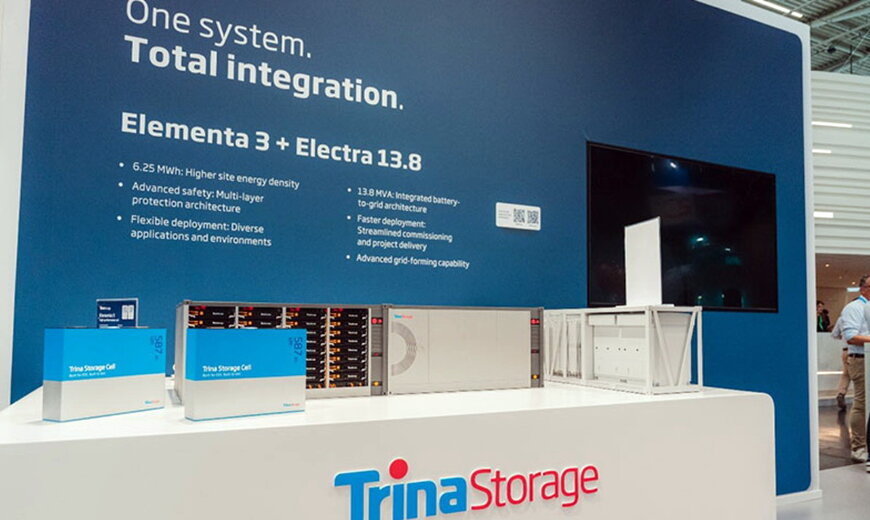
Trina Storage introduced an integrated DC and AC utility-scale battery energy storage system. The platform combines battery energy storage and power conversion technologies to streamline installation processes and support grid stability in large-scale renewable applications.
Technical Performance and Architectural Integration
The storage system integrates the Elementa battery enclosure and the Electra AC platform to deliver 25 megawatt-hours of capacity and 13.8 megavolt-amperes of AC output. This unified DC-and-AC architecture minimizes field-wiring requirements and reduces overall engineering complexity. Auxiliary transformers are integrated directly into the layout, reducing the required physical footprint on project sites and optimizing land utilization.
Thermal management relies on a three-tier liquid cooling system designed to regulate cell temperatures uniformly. This mechanism maintains a temperature differential of less than 2.5 degrees Celsius across all integrated cells, preventing localized hot spots and limiting degradation rates.
Grid Stabilization and Safety Mechanisms
The system is designed for demanding grid environments, utilizing advanced power electronics to achieve a 10-millisecond full-power response time. The Electra platform provides dynamic active and reactive power control alongside grid-forming and black-start capabilities, allowing the installation to stabilize local networks and assist in grid recovery operations during outages.
Safety functions are distributed across a coordinated DC-to-AC protective architecture. This framework includes multi-layer electrical safeguards and targeted thermal protection technologies to mitigate runaway risks and maintain stable operation under varying load conditions.
Logistics Optimization and Validation
To minimize deployment schedules, both the DC and AC units use standard containerized designs compatible with global freight networks, which reduces transport complexity. Hardware configurations undergo pre-commissioning testing at the system integration validation facility of the manufacturer. This factory-level validation reduces on-site commissioning time by up to 50 percent compared to conventional non-integrated storage assets.
The manufacturer also displayed its 587-ampere-hour battery cell technology at the event, which underpins the density improvements found in current utility systems. Shawn Deng, Head of global product and system integration at Trina Storage, stated that utility-scale market demands have shifted toward integrated designs that provide higher performance, reliable operation, and lower total project economics.
Additional Context
This section details technical specifications and competitive benchmarking not included in the original product announcement
The utility-scale energy storage sector increasingly relies on high-capacity cells, moving from 280-ampere-hour benchmarks to 500-ampere-hour and larger form factors to achieve higher volumetric energy density. The integration of 587-ampere-hour cells within a 25-megawatt-hour block puts this system in direct competition with contemporary utility-scale platforms, such as the Tesla Megapack 2XL and the Sungrow PowerTitan series.
While typical industrial configurations traditionally separate the direct-current battery enclosures from the alternating-current inverters, modern competitive designs converge on unified platforms to reduce field labor. The 10-millisecond response time achieved by the Electra platform matches standard industry requirements for fast frequency response, which is a key requirement for displacing conventional thermal generation assets. Maintaining cell temperature deltas below 2.5 degrees Celsius aligns with high-tier utility standards, comparable to liquid-cooling systems from competing tier-one manufacturers that target thermal boundaries between 2 and 3 degrees Celsius to maximize operational life.
Edited by Evgeny Churilov, Induportals Media - Adapted by AI.
www.trinasolar.com
