
www.technology4environment.com
05
'26
Written on Modified on
Fraunhofer IPM Develops Compact System for On-Site Nitrous Oxide Measurement
Fraunhofer researchers introduce a portable, cost-effective photoacoustic sensor to optimize nitrogen fertilization and reduce greenhouse gas emissions.
www.fraunhofer.de
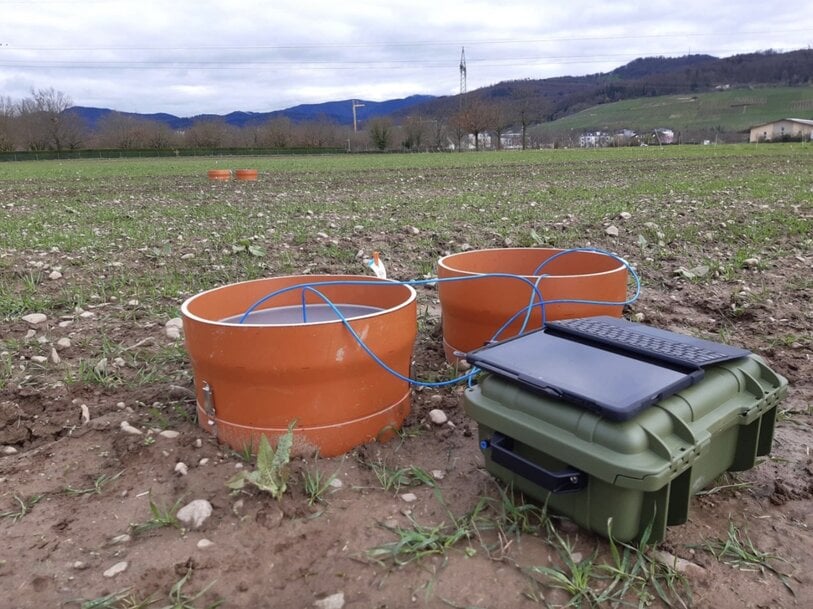
The Fraunhofer Institute for Physical Measurement Techniques IPM has developed an industrial-grade, portable measurement system designed to detect nitrous oxide (N2O) emissions directly from farmland. As the third most significant greenhouse gas, nitrous oxide is primarily generated through nitrogen fertilization in agriculture. The new system aims to make fertilization more efficient, helping to mitigate environmental impacts such as groundwater nitrate contamination and atmospheric warming.
Resonant Photoacoustic Measurement Technology
The measurement system, developed under the ESKILA project, utilizes resonant photoacoustics to achieve high sensitivity in a compact, 5.5-kilogram suitcase-shaped design. This method differs from traditional absorption spectroscopy by measuring generated sound waves rather than absorbed light:
- Signal Generation: A laser wavelength is modulated to cause gas molecules to move, creating pressure changes that generate an acoustic signal.
- Amplification: The measuring cell acts as a resonator to significantly amplify the signal at a specific modulation frequency.
- Detection: A standard MEMS microphone—similar to those used in smartphones—captures the signal; higher nitrous oxide concentrations result in a louder acoustic output.
Field Application and Reliability
During operation, nitrous oxide is captured from the soil using flux chambers and pumped into the system's measuring cell for analysis. To ensure data reliability under varying agricultural conditions, the system includes an integrated humidification module that maintains constant moisture levels, preventing humidity fluctuations from interfering with the photoacoustic measurement. This field-capable setup replaces traditional, time-consuming laboratory analysis of gas samples.
Environmental and Operational Impact
The system enables a direct, systematic comparison of different fertilization strategies, such as conventional broadcast fertilization versus deep-soil depot fertilization. By providing rapid data on how soil responds to nitrogen, the technology allows for the optimization of fertilizer quantities, which can reduce emissions while potentially increasing crop yields. Beyond nitrous oxide, the platform is configurable to detect other gases relevant to climate-aware agriculture, including ammonia (NH3) and carbon dioxide (CO2).
Additional Context
The development of on-site N2O sensing addresses a critical "data gap" in precision agriculture. Nitrous oxide emissions from soil are highly episodic—often referred to as "hot moments"—triggered by specific rainfall events or fertilization cycles. Traditional lab-based sampling often misses these peaks, leading to inaccurate models of a farm's true carbon footprint.
Technically, the use of a MEMS microphone for gas detection is a significant innovation in ruggedizing laboratory-grade equipment for the field. By utilizing photoacoustic spectroscopy, the system avoids the need for long optical path lengths or fragile mirrors required by conventional infrared sensors. This allows the device to maintain its ±0.02 mm-equivalent precision in a highly portable form factor. Furthermore, the ability to differentiate between N2O and other gases in real-time is vital for managing "depot fertilization" (placing fertilizer 20 cm deep). This technique relies on maintaining the nitrogen in a stable ammonium form; the Fraunhofer system can verify this by monitoring N2O flux at the surface, ensuring that the fertilizer is being utilized by the crop rather than being lost to the atmosphere through microbiological denitrification.
Edited by Romila DSilva, Induportals Editor, with AI assistance.
During operation, nitrous oxide is captured from the soil using flux chambers and pumped into the system's measuring cell for analysis. To ensure data reliability under varying agricultural conditions, the system includes an integrated humidification module that maintains constant moisture levels, preventing humidity fluctuations from interfering with the photoacoustic measurement. This field-capable setup replaces traditional, time-consuming laboratory analysis of gas samples.
Environmental and Operational Impact
The system enables a direct, systematic comparison of different fertilization strategies, such as conventional broadcast fertilization versus deep-soil depot fertilization. By providing rapid data on how soil responds to nitrogen, the technology allows for the optimization of fertilizer quantities, which can reduce emissions while potentially increasing crop yields. Beyond nitrous oxide, the platform is configurable to detect other gases relevant to climate-aware agriculture, including ammonia (NH3) and carbon dioxide (CO2).
Additional Context
The development of on-site N2O sensing addresses a critical "data gap" in precision agriculture. Nitrous oxide emissions from soil are highly episodic—often referred to as "hot moments"—triggered by specific rainfall events or fertilization cycles. Traditional lab-based sampling often misses these peaks, leading to inaccurate models of a farm's true carbon footprint.
Technically, the use of a MEMS microphone for gas detection is a significant innovation in ruggedizing laboratory-grade equipment for the field. By utilizing photoacoustic spectroscopy, the system avoids the need for long optical path lengths or fragile mirrors required by conventional infrared sensors. This allows the device to maintain its ±0.02 mm-equivalent precision in a highly portable form factor. Furthermore, the ability to differentiate between N2O and other gases in real-time is vital for managing "depot fertilization" (placing fertilizer 20 cm deep). This technique relies on maintaining the nitrogen in a stable ammonium form; the Fraunhofer system can verify this by monitoring N2O flux at the surface, ensuring that the fertilizer is being utilized by the crop rather than being lost to the atmosphere through microbiological denitrification.
Edited by Romila DSilva, Induportals Editor, with AI assistance.
