
www.technology4environment.com
02
'26
Written on Modified on
Fraunhofer Develops Bio-Based Flame Retardants from Corn Steep Liquor
Fraunhofer researchers are focusing on sustainable phosphorus-based raw materials derived from corn steep liquor; the phytic acid it contains is an excellent natural flame retardant for biomaterials.
www.fraunhofer.de
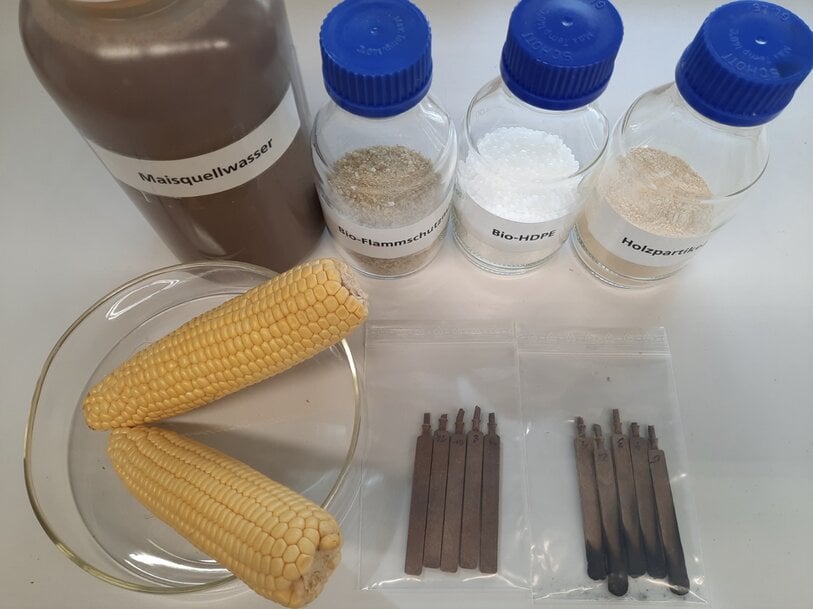
Researchers from the Fraunhofer Institute for Wood Research (Fraunhofer WKI) and the Fraunhofer Institute for Applied Polymer Research (Fraunhofer IAP) have developed a sustainable, phosphorus-based flame retardant using phytic acid extracted from corn steep liquor.
Conducted under the collaborative ScaleAmP research initiative, the project addresses environmental, toxicity, and resource-depletion issues linked to conventional halogenated additives and mined phosphorus. By utilizing corn steep liquor—an abundant industrial byproduct of wet-milling maize starch production—the research team has synthesized bio-based ammonium phytates suitable for wood-plastic composites (WPCs) and other biomaterial systems.
Sustainable Extraction and Synergistic Formulation
While commercial halogenated compounds deliver fire-suppression capabilities, their environmental persistence, toxicity, and impending regulatory restrictions are accelerating the demand for circular alternatives. Pure phytic acid contains high concentrations of bio-based phosphorus, yet its strong natural acidity and low pH render it incompatible with direct polymer compounding.
To resolve processing and chemical limitations, the research institutes engineered an end-to-end extraction and formulation methodology:
- Fractionation and Purification: Researchers at Fraunhofer IAP developed a mechanical-chemical separation process that isolates phytic acid from the liquid phase of corn steep liquor by adjusting pH and precipitating out organic acids, free amino acids, and residual proteins.
- Amine Screening and Synergism: Because phosphorus requires a coordinated nitrogen donor to form an effective protective barrier during combustion, Fraunhofer WKI screened over 20 different amine compounds to synthesize optimized ammonium phytates.
- Thermal Char Formation: Upon thermal exposure, the synthesized ammonium phytates generate an expanded, non-combustible carbonaceous intumescent char layer that cuts off atmospheric oxygen transfer and insulates the underlying substrate.
Validation and Commercial Scalability
The synthesized ammonium phytate formulations were compounded with wood particles and bio-based high-density polyethylene (bio-HDPE) matrix resins to produce standardized WPC test specimens. In rigorous flammability assessments—including the UL 94 vertical burning test and the limiting oxygen index (LOI)—the top-performing ammonium phytate formulations matched the fire-suppression performance of conventional commercial benchmark additives.
Having validated the extraction protocol at a 1-kilogram bench scale, the consortium is preparing pilot-scale trials targeting 100 kilograms. Future developments will assess alternative agricultural processing residues—including rice and wheat bran—to establish regional raw-material supply resilience for building, automotive, and furniture manufacturing applications.
Edited by Romila DSilva, Induportals Editor, with AI assistance.
The synthesized ammonium phytate formulations were compounded with wood particles and bio-based high-density polyethylene (bio-HDPE) matrix resins to produce standardized WPC test specimens. In rigorous flammability assessments—including the UL 94 vertical burning test and the limiting oxygen index (LOI)—the top-performing ammonium phytate formulations matched the fire-suppression performance of conventional commercial benchmark additives.
Having validated the extraction protocol at a 1-kilogram bench scale, the consortium is preparing pilot-scale trials targeting 100 kilograms. Future developments will assess alternative agricultural processing residues—including rice and wheat bran—to establish regional raw-material supply resilience for building, automotive, and furniture manufacturing applications.
Edited by Romila DSilva, Induportals Editor, with AI assistance.
