
www.technology4environment.com
07
'26
Written on Modified on
Fraunhofer Develops High-Performance Construction Textiles from Waste Plastics
A pilot-scale research program examines how chemical and solvent-based recycling can convert unused plastic waste streams into technical textiles and biodegradable geotextiles for construction applications.
www.fraunhofer.de

© Fraunhofer LBF/Raapke: The Fraunhofer institutes attach particular importance to the practical relevance of their new developments. This example shows the use of geosynthetics in riverbank stabilization.
As demand grows for circular materials in construction, researchers at the Fraunhofer Cluster of Excellence Circular Plastics Economy CCPE are investigating how previously unused plastic waste streams can be converted into high-performance roof underlayments and geosynthetics. Within the Zirk-Tex project, Fraunhofer institutes are analyzing the full value chain—from waste sorting and recycling through fiber production and application—to determine whether recycled and bio-based polymers can meet the stringent processing and durability requirements of technical textile products.
Recovering PP and PET for Technical Nonwovens
Polypropylene (PP) and polyethylene terephthalate (PET) dominate the market for roofing membranes and nonwoven underlayments, with several hundred million square meters installed annually in Europe. However, producing filament-based textiles from recyclates places significantly higher demands on material purity and stability than injection molding. Even small amounts of contaminants can disrupt melt spinning, leading to filament breakage and costly production downtime.
To address this, Fraunhofer CCPE partners—including Fraunhofer IME and Fraunhofer IOSB—evaluated waste sorting strategies and advanced recycling methods at pilot scale. Using solvent-based recycling, researchers successfully separated PP from mixed plastic waste streams initially containing 67 percent foreign polymers, reducing unwanted components to below 2 percent polyethylene. The resulting recyclate demonstrated sufficient thermal stability for further processing into multifilament yarns and membranes.
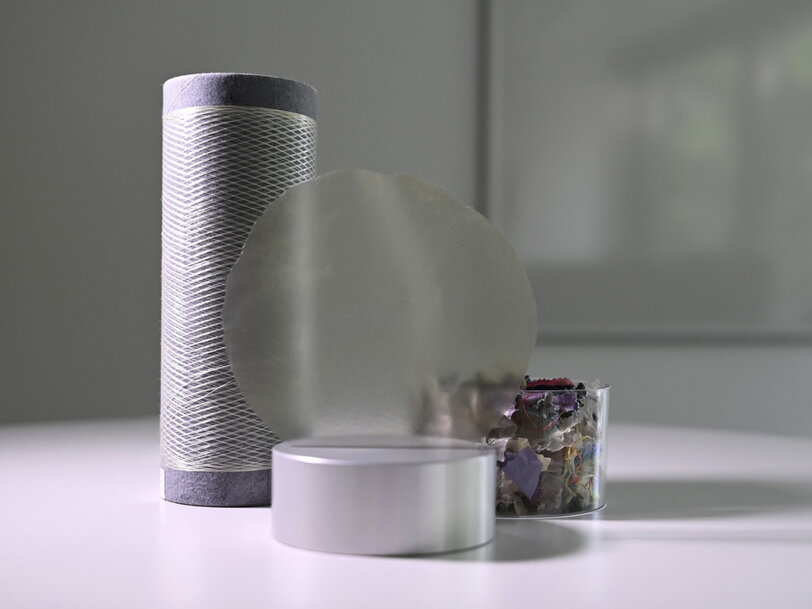
© Fraunhofer IVV: Fibers and films made from recycled polypropylene from packaging waste
Chemical Recycling and Melt Spinning of PET
For PET waste streams, the project assessed glycolysis followed by repolymerization. PET trays containing 13 percent impurities were depolymerized into bis(2-hydroxyethyl) terephthalate (BHET) and subsequently repolymerized into recycled PET suitable for melt spinning. Pilot-scale trials produced multifilament yarns with stable processing behavior, confirming that both solvent-based and chemical recycling routes can yield fibers suitable for technical nonwovens.
Residues from both recycling approaches were further valorized via pyrolysis, producing gas or oil fractions with low coke content, indicating additional potential for material recovery beyond textile applications.
Life Cycle Assessment and Infrastructure Challenges
Material flow analysis and life cycle assessment showed that the newly developed value chains offer a better climate footprint than the use of virgin plastics for both recyclate- and biopolymer-based products. While sufficient quantities of PP and PET waste are available, the study identified logistics and sorting infrastructure as key challenges that must be addressed to enable industrial-scale implementation.
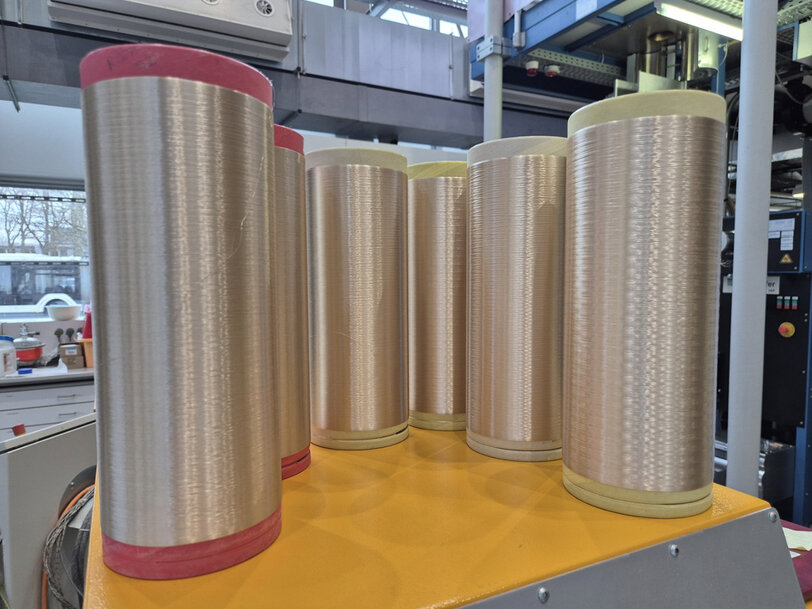
© Fraunhofer IAP: Multifilament yarns made from recycled PET
Controlled Biodegradation for Temporary Geotextiles
In a second application scenario, Fraunhofer CCPE investigated biodegradable geotextiles made from polylactide (PLA) and polybutylene succinate (PBS) for short-term civil engineering uses such as slope stabilization and temporary access roads. Using tailored additives, researchers achieved fibers that remain mechanically stable during use but degrade in a controlled manner afterward.
Soil storage tests conducted over 25 weeks at 40°C and 90 percent relative humidity demonstrated adjustable degradation behavior without adverse ecotoxicological effects. These results indicate that PLA- and PBS-based geotextiles can be engineered to meet both functional and environmental requirements for temporary construction applications.
Outlook for Circular Construction Materials
The Zirk-Tex project demonstrates that previously unused plastic waste streams and bio-based polymers can be transformed into high-quality technical textiles when recycling, additivation, and processing are considered as an integrated system. According to Fraunhofer CCPE, the findings provide a concrete development pathway for scalable, circular materials in roofing and geotechnical applications, with further industrial collaboration planned to move toward commercialization.
www.fraunhofer.com
As demand grows for circular materials in construction, researchers at the Fraunhofer Cluster of Excellence Circular Plastics Economy CCPE are investigating how previously unused plastic waste streams can be converted into high-performance roof underlayments and geosynthetics. Within the Zirk-Tex project, Fraunhofer institutes are analyzing the full value chain—from waste sorting and recycling through fiber production and application—to determine whether recycled and bio-based polymers can meet the stringent processing and durability requirements of technical textile products.
Recovering PP and PET for Technical Nonwovens
Polypropylene (PP) and polyethylene terephthalate (PET) dominate the market for roofing membranes and nonwoven underlayments, with several hundred million square meters installed annually in Europe. However, producing filament-based textiles from recyclates places significantly higher demands on material purity and stability than injection molding. Even small amounts of contaminants can disrupt melt spinning, leading to filament breakage and costly production downtime.
To address this, Fraunhofer CCPE partners—including Fraunhofer IME and Fraunhofer IOSB—evaluated waste sorting strategies and advanced recycling methods at pilot scale. Using solvent-based recycling, researchers successfully separated PP from mixed plastic waste streams initially containing 67 percent foreign polymers, reducing unwanted components to below 2 percent polyethylene. The resulting recyclate demonstrated sufficient thermal stability for further processing into multifilament yarns and membranes.
© Fraunhofer IVV: Fibers and films made from recycled polypropylene from packaging waste
Chemical Recycling and Melt Spinning of PET
For PET waste streams, the project assessed glycolysis followed by repolymerization. PET trays containing 13 percent impurities were depolymerized into bis(2-hydroxyethyl) terephthalate (BHET) and subsequently repolymerized into recycled PET suitable for melt spinning. Pilot-scale trials produced multifilament yarns with stable processing behavior, confirming that both solvent-based and chemical recycling routes can yield fibers suitable for technical nonwovens.
Residues from both recycling approaches were further valorized via pyrolysis, producing gas or oil fractions with low coke content, indicating additional potential for material recovery beyond textile applications.
Life Cycle Assessment and Infrastructure Challenges
Material flow analysis and life cycle assessment showed that the newly developed value chains offer a better climate footprint than the use of virgin plastics for both recyclate- and biopolymer-based products. While sufficient quantities of PP and PET waste are available, the study identified logistics and sorting infrastructure as key challenges that must be addressed to enable industrial-scale implementation.
© Fraunhofer IAP: Multifilament yarns made from recycled PET
Controlled Biodegradation for Temporary Geotextiles
In a second application scenario, Fraunhofer CCPE investigated biodegradable geotextiles made from polylactide (PLA) and polybutylene succinate (PBS) for short-term civil engineering uses such as slope stabilization and temporary access roads. Using tailored additives, researchers achieved fibers that remain mechanically stable during use but degrade in a controlled manner afterward.
Soil storage tests conducted over 25 weeks at 40°C and 90 percent relative humidity demonstrated adjustable degradation behavior without adverse ecotoxicological effects. These results indicate that PLA- and PBS-based geotextiles can be engineered to meet both functional and environmental requirements for temporary construction applications.
Outlook for Circular Construction Materials
The Zirk-Tex project demonstrates that previously unused plastic waste streams and bio-based polymers can be transformed into high-quality technical textiles when recycling, additivation, and processing are considered as an integrated system. According to Fraunhofer CCPE, the findings provide a concrete development pathway for scalable, circular materials in roofing and geotechnical applications, with further industrial collaboration planned to move toward commercialization.
www.fraunhofer.com
