
www.technology4environment.com
04
'26
Written on Modified on
Hyundai Motor Group at World Hydrogen Expo 2026
From November 4-6, in Goyang-si, South Korea, the company presented modular electrolysis infrastructure, high-durability fuel cells, and automated refuelling systems.
www.hyundaimotorgroup.com
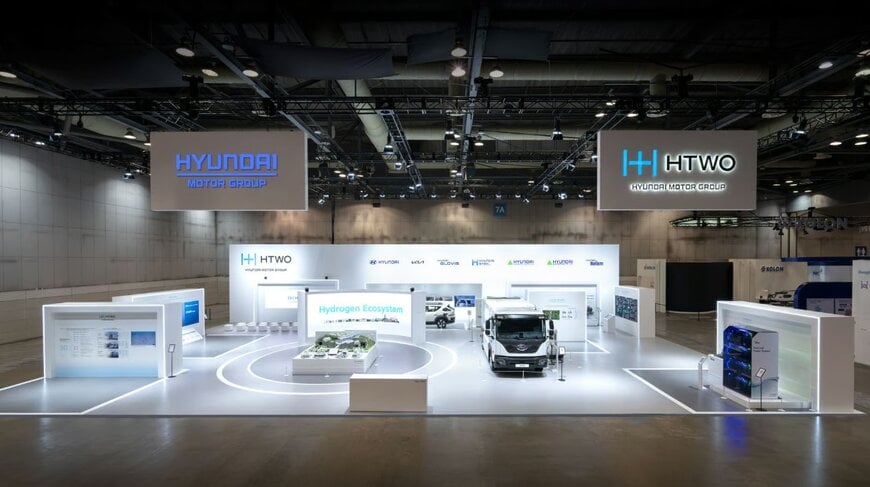
Hyundai Motor Group presented integrated industrial systems covering modular hydrogen production, commercial vehicle drivetrains, and municipal infrastructure. The technical demonstrations address primary engineering constraints in localized fuel production, heavy fleet maintenance, and end-use scaling across logistics networks.
Core Technology and System Architecture
The core of the production display is a modular polymer electrolyte membrane electrolysis platform designed for industrial scaling. Twelve individual stacks combine into a single 5-megawatt-class electrolyzer system module capable of generating approximately 700 metric tons of hydrogen per year. The architecture allows multi-unit stacking to reach several hundred megawatts. For decentralized generation, locally integrated waste-to-hydrogen processing routes organic biogas directly into pure hydrogen streams through dedicated reforming and purification stages.
Deployment or Implementation
Operational validation of the 5-megawatt-class architecture is based on an active 1-megawatt containerized demonstration facility in Gwangju, Korea, with engineering deployments underway in Boryeong, Buan, and Jeju. The waste-to-hydrogen systems are deployed through HTWO Energy Cheongju and an active biogas conversion facility in Paju, alongside international testing initiatives in Indonesia. Infrastructure automation was demonstrated through the Automatic Charging Robot-Hydrogen, an automated robotic coupling designed to interface directly with vehicle receptacles on heavy-duty municipal cleaning trucks during high-pressure dispensing cycles.
Industry Applications
The presented technologies target heavy transport, rail networks, logistics hubs, and industrial energy supply. Commercial transportation hardware includes an enhanced-durability fuel cell system featuring strengthened membrane electrode assemblies engineered to withstand continuous commercial duty cycles. For long-distance freight, a flat-profile fuel cell module was configured for high-volume locomotive traction systems. In distributed infrastructure concepts such as the Saemangeum AI Valley, electrolysis plants couple directly with dedicated solar arrays to supply power to artificial intelligence data centers, manufacturing plants, and municipal utility networks.
Operational Impact and Performance Metrics
The modular electrolysis configuration reduces footprint constraints and maintenance downtime through stack-level interchangeability rather than full-system shutdowns. Fleet reliability is monitored via the Bluelink Uptime Care management system, which uses real-time telemetry to track individual stack voltages, component degradation rates, and predictive diagnostics. Operational safety and cycle times at refueling points are optimized through robotic automation, removing manual handling in high-throughput terminal environments.
Edited by Evgeny Churilov, Induportals Media - Adapted by AI.
www.hyundaimotorgroup.com
