
www.technology4environment.com
30
'26
Written on Modified on
Vattenfall builds Germany’s largest offshore wind farm at scale
Nordlicht I and II will deploy 112 turbines totaling 1.61 GW, generating 6 TWh annually for 1.7 million households.
group.vattenfall.com
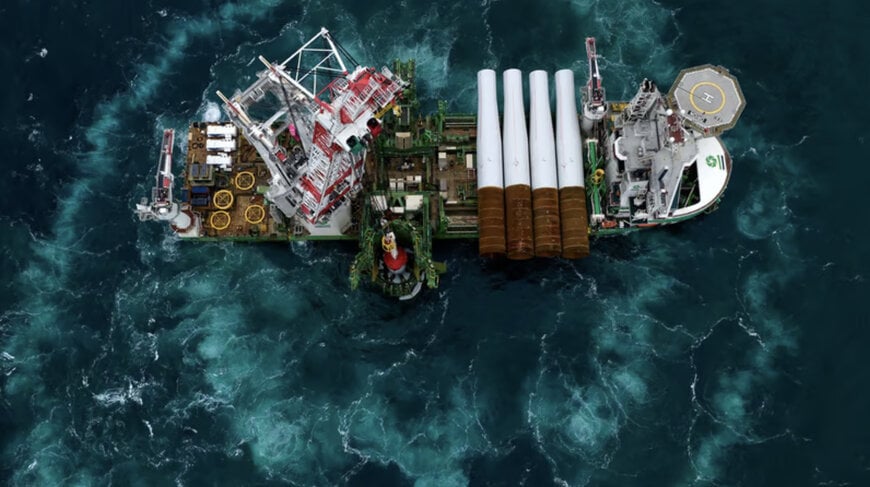
European energy-intensive manufacturers face growing regulatory pressure to decarbonize industrial baseload operations while safeguarding grid reliability against volatile natural gas markets. Developing utility-scale generation at distance from shore introduces severe logistical and structural engineering bottlenecks, including deep-water foundation driving, legacy maritime hazard mitigation, and complex offshore vessel sequencing. To establish a subsidy-free domestic source of fossil-free electricity, Vattenfall initiated offshore foundation installation on the Nordlicht cluster in the German North Sea, designed to deliver approximately 1.61 gigawatts of generation capacity across two adjacent phases.
Subsea Geotechnical Preparation and Marine Ordnance Remediation
Located 85 kilometers north of the island of Borkum, the construction zone required extensive geotechnical and geophysical seabed mapping before marine installation campaigns could commence. Continuous bathymetric surveys and magnetometer scans identified magnetic anomalies across the deployment footprint, leading to the identification of three unexploded Second World War sea mines containing explosive charges between 200 and 300 kilograms of TNT equivalent.
Controlled underwater detonations were executed on site in September 2025. To mitigate acoustic shockwaves that induce physiological trauma in marine mammals, installation teams deployed double-layer bubble curtains around the blast radius. Compressed air injected through subsea ring manifolds formed a rising curtain of air bubbles that dampened underwater acoustic transmission, attenuating peak pressure waves within surrounding habitats.
Foundation Engineering and Heavy-Lift Turbine Logistics
The project consists of two linked assets: Nordlicht I, comprising 68 wind turbines with an installed capacity of 980 megawatts scheduled for commissioning in 2028, and Nordlicht II, adding 44 turbines and 630 megawatts planned for commercial operation in 2029. Across both project phases, the system will deliver six terawatt-hours of power annually, matching the electricity consumption of 1.7 million households.
Structural loads are supported by 112 steel monopile foundations driven directly into the seabed, connected to matching transition pieces. Individual monopiles reach lengths up to 80 meters and weigh up to 1,300 tonnes. The generation superstructure incorporates Vestas 15-megawatt offshore turbines; a single rotor revolution generates sufficient electrical energy to satisfy the daily power demand of four private households.
To address the embodied carbon footprint of the balance of plant, the turbine towers integrate low-emission steel, reducing total tower manufacturing emissions by approximately 16 percent compared to conventional steel configurations. Downstream subsea array and export cabling specify recycled copper and steel, low-emission aluminum conductors, and bitumen-free protective sheathings.
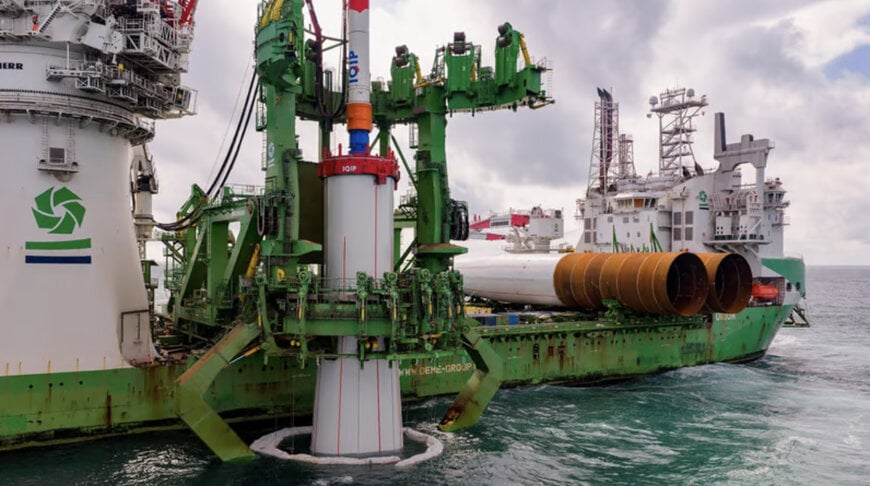
Corporate Power Offtake and Industrial Decarbonization Integration
Nordlicht operates on a merchant basis without direct state subsidization, relying on bilateral corporate power purchase agreements (PPAs) to support financial close and commercial viability. Heavy industrial consumers—including steel manufacturer Salzgitter and chemical producer LyondellBasell—have contracted long-term off-take volumes directly from the cluster. This commercial structure directly channels renewable megawatt-hours into primary electric arc furnaces and polymer synthesis facilities, insulating manufacturing operations from fossil fuel cost exposure.
Ongoing operations involve continuous environmental monitoring matrices combining aerial wildlife observation, radar tracking, vessel-based transects, and acoustic receivers to quantify avian and marine mammal behavior across construction and operational regimes.
Additional Context:
This section details technical specifications and competitive benchmarking not included in the original product announcement.
The deployment of 15-megawatt nacelles on the Nordlicht cluster reflects a technological migration toward ultra-large offshore turbine architectures in European waters. The Vestas V236-15.0 MW platform utilizes a 236-meter rotor diameter delivering an active swept area of 43,742 square meters, engineered with 115.5-meter blades operating under IEC Class I/S wind conditions. This size class provides a substantial output expansion over the 8-megawatt to 11-megawatt turbines installed in previous-generation North Sea commercial arrays.
In the German North Sea offshore sector, benchmark operational clusters include RWE's Kaskasi project (342 MW) and the EnBW Hohe See and Albatros development (609 MW combined). While earlier assets utilized smaller monopile profiles (typically 6 to 7 meters in diameter) and smaller turbine platforms (such as the Siemens Gamesa SG 8.0-167 DD), the 1.61-gigawatt Nordlicht cluster scales foundation engineering to handle 80-meter, 1,300-tonne monopiles accommodating bottom-fixed hub heights over 140 meters. At 980 megawatts for Nordlicht I and 630 megawatts for Nordlicht II, the combined 112-turbine development establishes Germany's largest contiguous offshore wind hub, matching the scale of contemporary international gigawatt-scale developments such as the Dutch Hollandse Kust Zuid and Borssele complexes.
Edited by Natania Lyngdoh, Induportals editor, with AI assistance.
www.group.vattenfall.com
