
www.technology4environment.com
22
'26
Written on Modified on
GE Vernova equips Brazilian gas plant to strengthen Amazon grid stability
Azulão I uses 7HA.02 technology and custom resonance protection to stabilize Brazil’s grid while supporting renewable energy integration.
www.gevernova.com
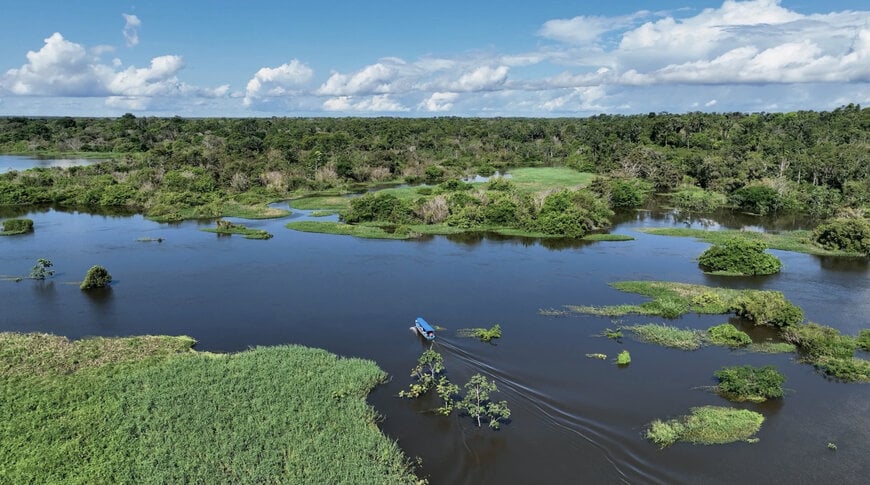
The rainforest in the Brazilian state of Amazonas, where teams from three GE Vernova businesses collaborated with power company Eneva to bring needed electricity to a 1,200-mile transmission corridor. Image credit: Shutterstock
GE Vernova has integrated high-efficiency gas turbine equipment and bespoke subsynchronous resonance mitigation technology at the 295-megawatt Azulão I thermal generation facility developed by Brazilian power producer Eneva. Located in the Amazon basin, the installation supplies flexible dispatchable power to Brazil’s National Interconnected System to counteract electrical instability stemming from expanding renewable capacity.
Interconnection Challenges and Torsional Oscillation Dynamics
Transmission corridors extending across large geographical territories rely on series capacitors to diminish line reactance and raise transmission line power-carrying limits. However, series-compensated high-voltage links can introduce subsynchronous resonance, an electrical condition where electrical oscillation frequencies in the transmission circuit align with the mechanical torsional modes of the turbine-generator shaft. If unmitigated, these electrical oscillations feed back through the generator stator, generating alternating torques that risk shearing heavy rotating drive shafts or initiating catastrophic hardware failures.
At Azulão I, electrical output is fed into the Tucuruí–Macapá–Manaus transmission corridor, a transmission line system spanning approximately 1,200 miles through remote regional topography. Interfacing a heavy-duty generation asset with this high-impedance, compensated line required predictive system studies prior to hardware deployment. Technical divisions within GE Vernova—encompassing Gas Power, Electrification, and Consulting Services—modeled grid behaviors under variable operational alignments, component outages, and line maintenance states to identify the exact resonant frequency thresholds of the generator-network interface.
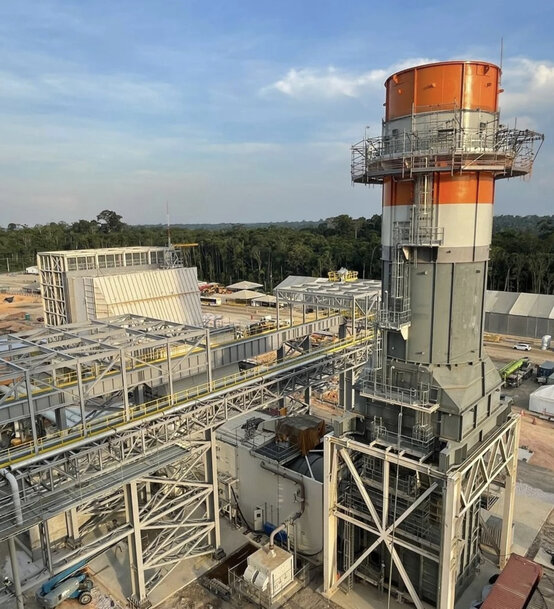
Azulão I, a 295-megawatt gas power plant developed by Eneva, feeds electricity through Brazil’s most demanding grid environment. Images credit: Eneva
Pre-Emptive Filter Engineering and Operating Protocols
Because standard grid-level capacitors do not counteract site-specific electrical resonance, engineering teams manufactured a custom electrical blocking filter mounted directly on the generator’s output bus. The device functions as a targeted frequency barrier, damping destructive electrical oscillations before they reach the rotor core. José Geraldo Barreto Monteiro de Andrade, Managing Director for Latin America at GE Vernova Consulting Services, stated that standard commercial components could not accommodate local grid resonances, necessitating a tailored filter calibrated to the specific risk parameters of the turbine-generator units.
Integrating this protection during the engineering phase prevented the need for post-commissioning retrofits. Ivette Castillo, General Manager of Grid Systems Integration for Latin America at GE Vernova, indicated that evaluating generation technology, grid stability systems, and transmission engineering as a single combined system permitted the early implementation of targeted safeguards.
Beyond physical filtration, the analytical studies yielded specialized dispatch procedures. Dynamic operational settings adapt turbine-generator operating limits when adjacent transmission circuits or compensation equipment are taken offline for servicing. These protocols govern the operation of the first installed unit and are being replicated across two subsequent units under a 15-year long-term services agreement covering plant maintenance and system engineering.
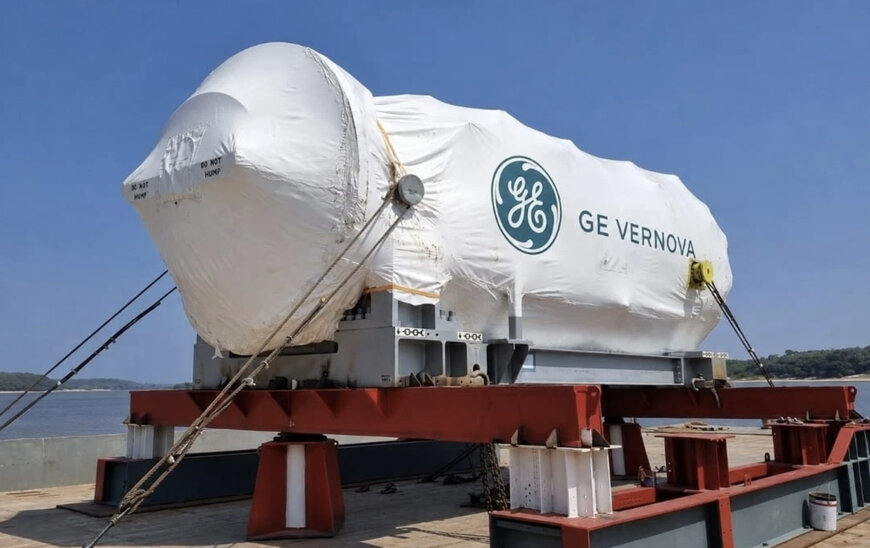
GE Vernova’s 7HA.02 gas turbine helps quickly compensate for fluctuations in wind and solar power, enabling more renewables to be integrated in remote locations like the Amazon.
Renewable Integration and Facility Expansion
Brazil’s Ten-Year Energy Expansion Plan projects that renewable energy sources will supply more than 85 percent of the country’s total electricity generation by 2035, driven by wind and solar installations. Because weather-dependent power sources exhibit high output variance, grid operators require thermal assets capable of ramp-rate modulation to balance intraday demand shifts and support baseline voltages.
The Azulão I facility relies on a 7HA.02 gas turbine designed to deliver load flexibility and rapid startup cycles. Marco Vera, General Director and Vice President of New Units for GE Vernova Gas Power in Latin America and the Caribbean, stated that fast-acting generation provides a necessary dispatchable complement to fluctuating renewable production. Azulão I represents the initial installation of a broader generation hub; the addition of the adjacent Azulão II phase is projected to expand the complex to 950 megawatts of cumulative installed capacity by the first quarter of 2027.
Additional Context:
This section details technical specifications and competitive benchmarking not included in the original product announcement
Heavy-duty gas turbines operating in the 50 Hz and 60 Hz segments provide primary balancing capacity for international utility grids. In the advanced H-class category, the GE Vernova 7HA.02 turbine operates at 60 Hz, delivering an open-cycle output of approximately 384 megawatts with a net efficiency exceeding 44 percent, expandable past 64 percent in combined-cycle configurations. Ramp rates for this platform reach up to 50 megawatts per minute, enabling fast transitions to mitigate sudden renewable output drop-offs.
Direct commercial alternatives in this power class include the Siemens Energy SGT6-8000H and the Mitsubishi Power M501JAC. The Siemens SGT6-8000H delivers approximately 310 megawatts in simple-cycle arrangement with a ramp rate of roughly 30 to 35 megawatts per minute, relying on an air-cooled architecture and an established single-shaft design. The Mitsubishi Power M501JAC operates at 440 megawatts in simple-cycle configuration with a ramp rate of 50 megawatts per minute, utilizing steam-cooled combustors and high-temperature thermal barrier coatings to sustain turbine inlet temperatures reaching 1,600°C.
Subsynchronous resonance mitigation across compensated utility networks typically follows two core technological methodologies: active mitigation via Flexible AC Transmission Systems (such as Thyristor-Controlled Series Capacitors or Static Synchronous Series Compensators) and passive mitigation via tuned inductive-capacitive-resistive (L-C-R) bus filters. While active FACTS devices modulate line reactance dynamically at the substation level, passive generator-terminal blocking filters directly isolate the generator stator from subsynchronous currents at specific critical frequencies, delivering localized protection without requiring external control loops or continuous active semiconductor switching.
Edited by Natania Lyngdoh, Induportals editor, assisted by AI.
www.gevernova.com
GE Vernova has integrated high-efficiency gas turbine equipment and bespoke subsynchronous resonance mitigation technology at the 295-megawatt Azulão I thermal generation facility developed by Brazilian power producer Eneva. Located in the Amazon basin, the installation supplies flexible dispatchable power to Brazil’s National Interconnected System to counteract electrical instability stemming from expanding renewable capacity.
Interconnection Challenges and Torsional Oscillation Dynamics
Transmission corridors extending across large geographical territories rely on series capacitors to diminish line reactance and raise transmission line power-carrying limits. However, series-compensated high-voltage links can introduce subsynchronous resonance, an electrical condition where electrical oscillation frequencies in the transmission circuit align with the mechanical torsional modes of the turbine-generator shaft. If unmitigated, these electrical oscillations feed back through the generator stator, generating alternating torques that risk shearing heavy rotating drive shafts or initiating catastrophic hardware failures.
At Azulão I, electrical output is fed into the Tucuruí–Macapá–Manaus transmission corridor, a transmission line system spanning approximately 1,200 miles through remote regional topography. Interfacing a heavy-duty generation asset with this high-impedance, compensated line required predictive system studies prior to hardware deployment. Technical divisions within GE Vernova—encompassing Gas Power, Electrification, and Consulting Services—modeled grid behaviors under variable operational alignments, component outages, and line maintenance states to identify the exact resonant frequency thresholds of the generator-network interface.
Azulão I, a 295-megawatt gas power plant developed by Eneva, feeds electricity through Brazil’s most demanding grid environment. Images credit: Eneva
Pre-Emptive Filter Engineering and Operating Protocols
Because standard grid-level capacitors do not counteract site-specific electrical resonance, engineering teams manufactured a custom electrical blocking filter mounted directly on the generator’s output bus. The device functions as a targeted frequency barrier, damping destructive electrical oscillations before they reach the rotor core. José Geraldo Barreto Monteiro de Andrade, Managing Director for Latin America at GE Vernova Consulting Services, stated that standard commercial components could not accommodate local grid resonances, necessitating a tailored filter calibrated to the specific risk parameters of the turbine-generator units.
Integrating this protection during the engineering phase prevented the need for post-commissioning retrofits. Ivette Castillo, General Manager of Grid Systems Integration for Latin America at GE Vernova, indicated that evaluating generation technology, grid stability systems, and transmission engineering as a single combined system permitted the early implementation of targeted safeguards.
Beyond physical filtration, the analytical studies yielded specialized dispatch procedures. Dynamic operational settings adapt turbine-generator operating limits when adjacent transmission circuits or compensation equipment are taken offline for servicing. These protocols govern the operation of the first installed unit and are being replicated across two subsequent units under a 15-year long-term services agreement covering plant maintenance and system engineering.
GE Vernova’s 7HA.02 gas turbine helps quickly compensate for fluctuations in wind and solar power, enabling more renewables to be integrated in remote locations like the Amazon.
Renewable Integration and Facility Expansion
Brazil’s Ten-Year Energy Expansion Plan projects that renewable energy sources will supply more than 85 percent of the country’s total electricity generation by 2035, driven by wind and solar installations. Because weather-dependent power sources exhibit high output variance, grid operators require thermal assets capable of ramp-rate modulation to balance intraday demand shifts and support baseline voltages.
The Azulão I facility relies on a 7HA.02 gas turbine designed to deliver load flexibility and rapid startup cycles. Marco Vera, General Director and Vice President of New Units for GE Vernova Gas Power in Latin America and the Caribbean, stated that fast-acting generation provides a necessary dispatchable complement to fluctuating renewable production. Azulão I represents the initial installation of a broader generation hub; the addition of the adjacent Azulão II phase is projected to expand the complex to 950 megawatts of cumulative installed capacity by the first quarter of 2027.
Additional Context:
This section details technical specifications and competitive benchmarking not included in the original product announcement
Heavy-duty gas turbines operating in the 50 Hz and 60 Hz segments provide primary balancing capacity for international utility grids. In the advanced H-class category, the GE Vernova 7HA.02 turbine operates at 60 Hz, delivering an open-cycle output of approximately 384 megawatts with a net efficiency exceeding 44 percent, expandable past 64 percent in combined-cycle configurations. Ramp rates for this platform reach up to 50 megawatts per minute, enabling fast transitions to mitigate sudden renewable output drop-offs.
Direct commercial alternatives in this power class include the Siemens Energy SGT6-8000H and the Mitsubishi Power M501JAC. The Siemens SGT6-8000H delivers approximately 310 megawatts in simple-cycle arrangement with a ramp rate of roughly 30 to 35 megawatts per minute, relying on an air-cooled architecture and an established single-shaft design. The Mitsubishi Power M501JAC operates at 440 megawatts in simple-cycle configuration with a ramp rate of 50 megawatts per minute, utilizing steam-cooled combustors and high-temperature thermal barrier coatings to sustain turbine inlet temperatures reaching 1,600°C.
Subsynchronous resonance mitigation across compensated utility networks typically follows two core technological methodologies: active mitigation via Flexible AC Transmission Systems (such as Thyristor-Controlled Series Capacitors or Static Synchronous Series Compensators) and passive mitigation via tuned inductive-capacitive-resistive (L-C-R) bus filters. While active FACTS devices modulate line reactance dynamically at the substation level, passive generator-terminal blocking filters directly isolate the generator stator from subsynchronous currents at specific critical frequencies, delivering localized protection without requiring external control loops or continuous active semiconductor switching.
Edited by Natania Lyngdoh, Induportals editor, assisted by AI.
www.gevernova.com
