
www.technology4environment.com
03
'26
Written on Modified on
Integrated Energy Storage for Urban and Regional Railway Infrastructures
ÖBB-Infrastruktur AG is implementing a combined photovoltaic and battery storage system for local energy supply and stabilization of the Austrian railway network.
www.oebb.at
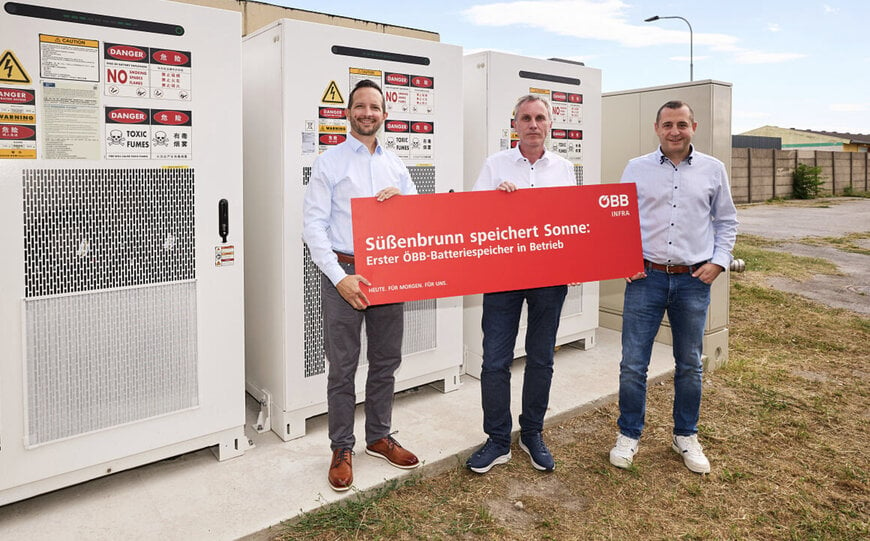
At the Süßenbrunn site, ÖBB-Infrastruktur AG is integrating a photovoltaic system with a new stationary battery storage system. This technical implementation aims to maximize the local use of renewable energies and temporally decouple the energy supply for railway operations from external power grids.
Operational Challenges and Collaboration
The operation of national railway infrastructures requires a continuous and fail-safe energy supply, which is increasingly affected by volatile energy markets and geopolitical tensions. To overcome these infrastructural challenges and sustainably strengthen the stability of the energy supply, ÖBB-Infrastruktur AG is planning and implementing the expansion of its self-supply capabilities. Technical collaboration within the business units makes it possible to link the generation of renewable energies directly to local consumption points, thereby reducing reliance on external power sources in Austria as a business location.
Technical Solution and Responsibilities
The system architecture combines a 50-Hertz photovoltaic system with stationary battery storage. The solar system comprises more than 1,300 roof-mounted modules, generating approximately 640 megawatt-hours of electricity annually. ÖBB-Infrastruktur AG is responsible for integrating the newly constructed battery storage system, which has a capacity of 645 kilowatt-hours and a charging power of 324 kilowatts. This hardware configuration is designed to physically store excess energy on-site and operationally decouple electricity production from local consumption.
Deployment and Implementation
The physical deployment of the infrastructure is taking place at the operating site in Süßenbrunn. The photovoltaic system was already transitioned into regular operation in 2025. In the current implementation phase, the battery storage is being connected to the existing solar infrastructure to form a smart local power grid for the site's energy supply. This facility is part of the operator's long-term energy strategy, which aims to continuously expand the more than 140 existing photovoltaic systems across the entire Austrian railway network.
Applications and Use Cases
This energy technology is applied directly to the local power supply of operational railway facilities and industrial sites. The functional use cases include storing solar power during production peaks and providing electrical energy on a time-delayed basis outside of daylight hours. By applying this storage architecture, the grid operator stabilizes self-consumption and ensures an uninterrupted power supply for the infrastructure-relevant processes at the site.
Results and Expected Impact
The integration of the storage system provides self-generated electricity on demand and reduces peak loads when drawing power from the public grid. The production volume of 640 megawatt-hours corresponds to the equivalent demand of about 160 households, measurably decreasing the site's external energy dependence. Regarding the strategic classification of the system's performance, Karl Streimelweger, Head of the Energy Business Unit at ÖBB-Infrastruktur AG, explains: "With the first battery storage facility in Süßenbrunn, we are showing how we not only generate renewable energy but also use it intelligently."
Edited by Maria Brueva, Induportals editor – adapted by AI.
www.oebb.at
