
www.technology4environment.com
22
'26
Written on Modified on
Advanced cable laying vessels optimize subsea power transmission infrastructure
Nexans deploys multi-turntable maritime platforms equipped with hybrid propulsion systems to sustain simultaneous high-voltage cable installation loops.
www.nexans.com
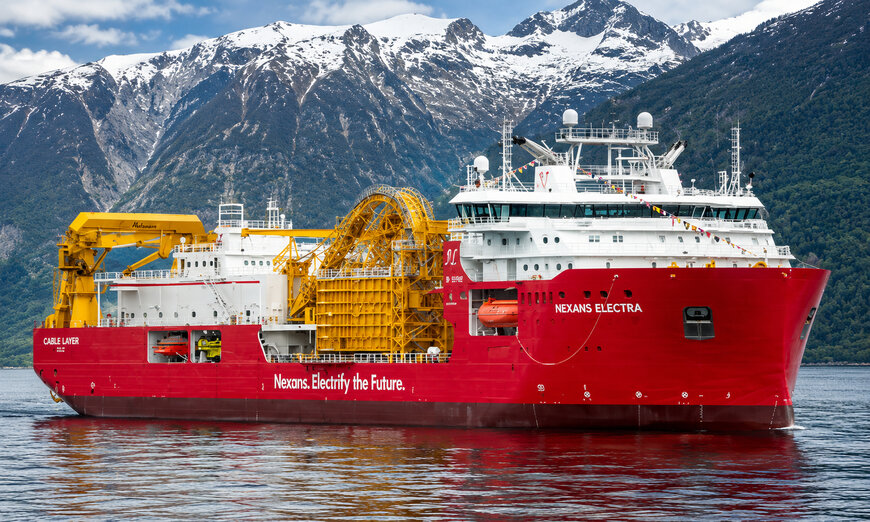
Nexans has announced the operational commissioning of its high-capacity cable laying vessel engineered to optimize power cable deployment across marine energy networks. This maritime infrastructure introduction incorporates specialized multi-turntable mechanics and subsea burial systems developed to sustain large-scale offshore wind farm connections and high-voltage direct current cross-border interconnectors.
To demonstrate these heavy-duty transmission logistics under variable ocean conditions, the vessel expands the group's global high-voltage offshore installation footprint. The deployment serves as a major scaling milestone as utility developers race to satisfy strict grid integration commitments worldwide.
Multi-turntable containment mechanics and simultaneous deployment routing
The severe mechanical loads and dynamic physical constraints of deep-water cable installation necessitate specialized vessel designs capable of resisting high structural stress and torsional forces during deployment. Operating as a utility-scale offshore asset, the vessel hull spans 149.9 meters in length and 31 meters in width, establishing a highly stable maritime staging environment. This structural geometry allows for the secure integration of three specialized turntables delivering a combined storage capacity of 13,500 tons.
By distributing the heavy cable weight across three separate rotating platforms, the architecture preserves uniform buoyancy limits and combats lateral deflection vectors during heavy sea states. The internal mechanical layout supports simultaneous deployment routines, enabling operators to lay up to four subsea cables concurrently from the stern assembly. This parallel processing capability lowers total offshore transit intervals and reduces overall exposure windows during high-risk installation loops.
The deployment infrastructure is backed by a full suite of specialized subsea burial and protection systems engineered to secure cables against maritime hazards. High-pressure water-jetting tools and heavy mechanical plows cut precise trenches directly into the seabed, embedding the high-voltage transmission lines smoothly beneath the sediment layer. This automated trenching process insulates the high-voltage systems from external mechanical stress caused by commercial anchors or deep-sea trawling assets, protecting grid link integrity.
Hybrid propulsion systems and automated power management profiles
To maintain strict positioning tolerances above target subsea cable paths without relying on passive anchoring lines, the vessel utilizes high-precision dynamic positioning systems coupled to an integrated hybrid propulsion block. The electrical configuration unifies battery energy storage banks and generator units compatible with biodiesel fuel blends to handle sudden load fluctuations cleanly. This hybrid configuration enables the vessel to buffer transient electrical load spikes locally, reducing total fossil fuel consumption margins during extended deep-water hovering operations.
The onboard power management software dynamically balances electrical routing across the thruster network, throttling inactive propulsion nodes based on real-time wind and current directions. This automated power allocation cuts down localized mechanical vibrations and acoustic feedback loops that could otherwise travel through the deployment matrix and cause signal issues in the cable tension monitoring instrumentation. The encapsulated engine compartment design minimizes thermal stress on adjacent power conversion systems, protecting localized logic buses from overheating during peak power delivery tasks.
The high-capacity power framework directly supports large-scale interconnector projects, providing the current delivery lines required for complex offshore connections. With an adjusted transmission backlog reaching 7.7 billion euros, the production framework is structured to secure extended infrastructure deployment schedules. This expanded deployment capability optimizes asset allocation parameters across complex deep-water environments, providing developers with clear visibility across active multi-year construction pipelines.
Additional Context: This section details technical specifications and competitive benchmarking not included in the original product announcement
Within the high-capacity subsea cable installation market, this advanced maritime platform enters direct technical competition with established purpose-built vessels such as the Leonardo da Vinci operated by Prysmian Group or the Living Stone managed by DEME. Objective engineering benchmarking reveals unique trade-offs regarding storage topology configurations and multi-cable deployment versatility. While conventional comparative installation assets rely on single or dual ultra-high-capacity turntables that expand the vessel's vertical center of gravity and limit multi-route versatility—requiring separate sub-interconnection campaigns that add integration overhead—the Nexans architecture relies on a modular three-turntable layout. This mechanical design distributes mass evenly across the main deck and stabilizes vessel orientation under intense environmental congestion.
Additionally, the development framework capitalizes on extensive high-voltage transmission history, building on a global track record spanning more than 443 interconnection installations representing 46 gigawatts of successfully commissioned grid capacity. This extensive baseline underpins the automated fault-clearing logic used in the deep-sea cable capstan networks. The group's existing deployment history includes demanding infrastructure layouts like the Celtic Interconnector between Ireland and France, the LanWin 2 network in Germany, and record-depth installations like the Tyrrhenian Link reaching 2,150 meters.
However, achieving maximum deployment efficiencies over extreme depths demands precise synchronization with modern subsea acoustic positioning networks and active tension compensation controllers. Sub-optimal calibration of the tension monitoring loops or elevated latencies across the hydraulic brake networks can induce localized strain spikes within the cable armoring layers, temporarily lowering safety margins compared to simplified shallow-water deployment configurations utilizing stationary, non-propelled barge linkages.
Edited by Sucithra Mani, Induportals editor – adapted by AI.
www.nexans.com
