
www.technology4environment.com
02
'26
Written on Modified on
JA Solar Showcases TOPCon Modules and C&I Storage
Integrated photovoltaic modules and battery system target commercial rooftops and industrial loads, combining high-power generation with monitored energy storage.
www.jasolar.eu
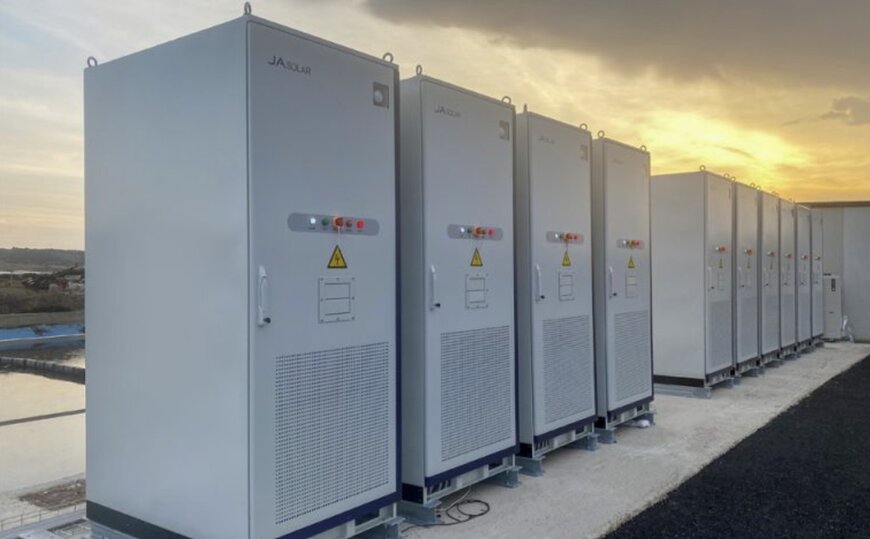
JAPlanet is a next-generation C&I battery storage solution designed to maximise solar profitability, flexibility and reliability.
Photovoltaic installations increasingly combine generation and storage to stabilise loads and improve on-site energy usage in the digital supply chain. At KEY – The Energy Transition Expo 2026 in Rimini, Italy (March 4–6, Rimini Expo Centre, Hall C1 Stand 301), JA Solar will present DeepBlue 5.0 n-type TOPCon modules and the JAPlanet commercial battery energy storage system.
Commercial rooftops and industrial loads in focus
The portfolio targets commercial and industrial (C&I) installations where high daytime production must align with variable consumption. Typical applications include logistics facilities, factories and large buildings with peak-demand tariffs or time-of-use pricing.
The DeepBlue 5.0 generation uses n-type TOPCon cell architecture. The JAM66D50 GB double-glass bifacial module delivers up to 670 W output. Bifacial construction enables rear-side irradiation capture, while glass-glass encapsulation improves mechanical stability and environmental resistance for rooftop and ground-mounted systems.
For mid-scale rooftops, the DeepBlue 4.0 Pro JAM60D40LB module provides 510 W in a similar double-glass bifacial format. A smaller JAM54D41-LB full-black series reaches up to 460 W and is suitable for residential and mixed-use buildings. This series has been installed at Signal Iduna Park in Dortmund, recognised by Rekord-Institut für Deutschland as a high-capacity photovoltaic stadium roof installation.
JA Solar will also present residential-scale modules in the mid-400 W range, available in monofacial and bifacial variants.
Storage added to the photovoltaic layer
To complement generation, JA Solar introduces the JAPlanet battery energy storage system designed for C&I energy management and smart grid interaction.
Each unit integrates a 261 kWh lithium iron phosphate (LFP) battery and a 125 kW Power Conversion System (PCS). The modular architecture scales to 20 units, reaching 5.2 MWh total capacity. Installations already operate in Italy via partner Noon srl.
Round-trip efficiency at the AC level is specified at 87%. Liquid cooling maintains cell temperature within ±1.5 °C to stabilise performance and reduce auxiliary consumption. Safety validation includes UL9540A testing, thermal-runaway detection, millisecond insulation monitoring and a three-stage fire-protection architecture.
The system carries a 5-year warranty with a minimum state-of-health of 80% or 8000 cycles. Remote diagnostics and predictive maintenance functions support continuous operation.
What the combined system enables
Coupling TOPCon modules with on-site storage supports peak shaving, demand-side management and time-of-use optimisation. In industrial facilities, excess daytime production can be stored and later used during high tariff periods or grid constraints.
By integrating generation and storage into one platform, EPC contractors and installers deploy a single photovoltaic and energy storage configuration rather than separate subsystems. This simplifies commissioning and supports higher on-site consumption rates in distributed energy systems.
www.jasolar.com
Photovoltaic installations increasingly combine generation and storage to stabilise loads and improve on-site energy usage in the digital supply chain. At KEY – The Energy Transition Expo 2026 in Rimini, Italy (March 4–6, Rimini Expo Centre, Hall C1 Stand 301), JA Solar will present DeepBlue 5.0 n-type TOPCon modules and the JAPlanet commercial battery energy storage system.
Commercial rooftops and industrial loads in focus
The portfolio targets commercial and industrial (C&I) installations where high daytime production must align with variable consumption. Typical applications include logistics facilities, factories and large buildings with peak-demand tariffs or time-of-use pricing.
The DeepBlue 5.0 generation uses n-type TOPCon cell architecture. The JAM66D50 GB double-glass bifacial module delivers up to 670 W output. Bifacial construction enables rear-side irradiation capture, while glass-glass encapsulation improves mechanical stability and environmental resistance for rooftop and ground-mounted systems.
For mid-scale rooftops, the DeepBlue 4.0 Pro JAM60D40LB module provides 510 W in a similar double-glass bifacial format. A smaller JAM54D41-LB full-black series reaches up to 460 W and is suitable for residential and mixed-use buildings. This series has been installed at Signal Iduna Park in Dortmund, recognised by Rekord-Institut für Deutschland as a high-capacity photovoltaic stadium roof installation.
JA Solar will also present residential-scale modules in the mid-400 W range, available in monofacial and bifacial variants.
Storage added to the photovoltaic layer
To complement generation, JA Solar introduces the JAPlanet battery energy storage system designed for C&I energy management and smart grid interaction.
Each unit integrates a 261 kWh lithium iron phosphate (LFP) battery and a 125 kW Power Conversion System (PCS). The modular architecture scales to 20 units, reaching 5.2 MWh total capacity. Installations already operate in Italy via partner Noon srl.
Round-trip efficiency at the AC level is specified at 87%. Liquid cooling maintains cell temperature within ±1.5 °C to stabilise performance and reduce auxiliary consumption. Safety validation includes UL9540A testing, thermal-runaway detection, millisecond insulation monitoring and a three-stage fire-protection architecture.
The system carries a 5-year warranty with a minimum state-of-health of 80% or 8000 cycles. Remote diagnostics and predictive maintenance functions support continuous operation.
What the combined system enables
Coupling TOPCon modules with on-site storage supports peak shaving, demand-side management and time-of-use optimisation. In industrial facilities, excess daytime production can be stored and later used during high tariff periods or grid constraints.
By integrating generation and storage into one platform, EPC contractors and installers deploy a single photovoltaic and energy storage configuration rather than separate subsystems. This simplifies commissioning and supports higher on-site consumption rates in distributed energy systems.
www.jasolar.com
