
www.technology4environment.com
26
'26
Written on Modified on
Siemens, CAPHENIA Partner to Scale Sustainable Aviation Fuel Production
This strategic partnership accelerates industrial scale-up of Sustainable Aviation Fuel (SAF), combining plasma-based synthesis gas production with advanced automation and digitalization technologies.
www.siemens.com
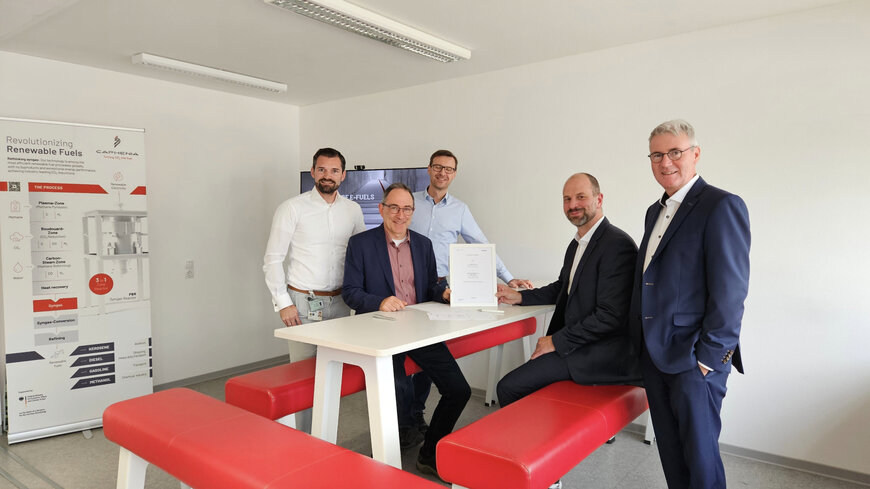
Siemens and CAPHENIA sign the partnership agreement. From left to right: Nicky Ahnert, Jürgen Giegerich, Frank Knauf (all Siemens), Dr. Mark Misselhorn, Dr. Andreas Waibel (both CAPHENIA)
Under the agreement, Siemens becomes CAPHENIA’s preferred automation and digitalization partner, supporting the transition from pilot-scale operations to global commercial deployment. The collaboration aims to standardize plant design and accelerate rollout using solutions from the Siemens Xcelerator portfolio.
Plasma technology for high-efficiency synthesis gas production
CAPHENIA’s process converts bio-methane into synthesis gas using plasma technology at temperatures of approximately 1,500°C. At the core of the system is the Plasma Boudouard Reactor (PBR), a 3-in-1 zone reactor that integrates three established chemical reactions within a single unit.
The generated synthesis gas can be processed into Sustainable Aviation Fuel, renewable diesel or chemical intermediates without producing unwanted by-products and with minimal energy losses.
A defining feature of the process is its internal heat recovery: thermal energy released during synthesis gas cooling is reused to preheat incoming bio-methane. This closed-loop approach results in process efficiencies exceeding 86 percent, significantly higher than conventional gas conversion technologies.
According to Christian Gückel, Head of Vertical Chemicals at Siemens Digital Industries, synthetic fuels are essential for aviation decarbonization, and scalable production capacity is urgently required. Siemens’ digitalization and automation technologies are designed to industrialize CAPHENIA’s plasma system and enable global market ramp-up.
Dr. Mark Misselhorn, founder and CEO of CAPHENIA, emphasized that rapid industrial scalability and strong technology partnerships are critical in a fragmented and fast-moving SAF market. The collaboration aims not only to support global deployment of the PBR platform but to position it as a leading solution in synthetic fuel production.
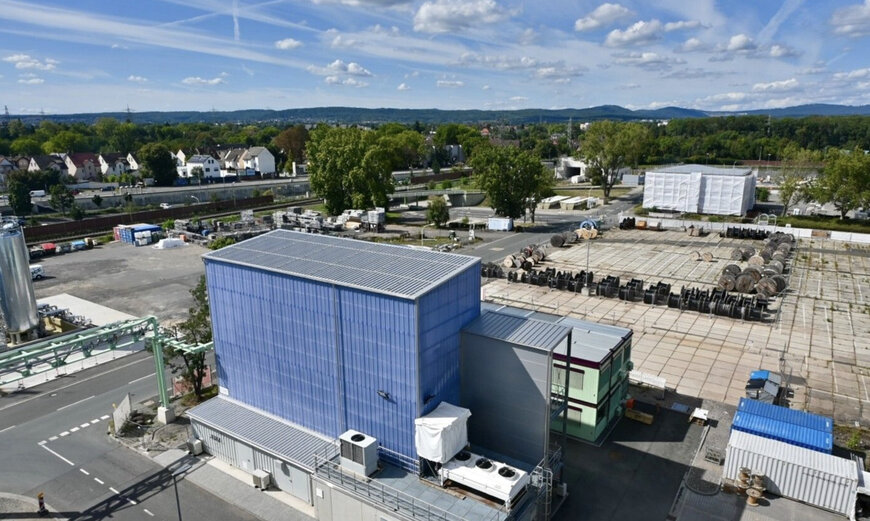
CAPHENIA's plasma Boudouard reactor in the Frankfurt-Höchst industrial park
Digitalization as a scaling enabler
As preferred supplier and technology partner, Siemens will provide process control systems, drive technology, instrumentation, process simulation software and digital twin capabilities. Digital twins will allow simulation and optimization of plant parameters before physical commissioning, while enabling consistent process control across multiple production sites.
Siemens is already supporting CAPHENIA at its pilot facility in the Höchst Industrial Park in Frankfurt, Germany. The next step is the development of a standardized, modular automation and digitalization template for the Plasma Boudouard Reactor. This template will be adaptable to various plant sizes and geographical locations, reducing commissioning time and accelerating new plant deployment.
Meeting rapidly growing SAF demand
The demand for Sustainable Aviation Fuel is increasing sharply due to regulatory requirements. The European Union Renewable Energy Directive (RED) mandates binding blending quotas, with penalties for non-compliance.
By 2050, global aviation is expected to require approximately 500 million tons of SAF annually. At present, SAF accounts for less than one percent of worldwide kerosene consumption. To close this gap, production technologies must combine high energy efficiency, scalability and industrial readiness.
The Siemens–CAPHENIA partnership is positioned to address these requirements by aligning plasma-based fuel synthesis with digitalized and standardized plant engineering for large-scale deployment.
www.siemens.com
Under the agreement, Siemens becomes CAPHENIA’s preferred automation and digitalization partner, supporting the transition from pilot-scale operations to global commercial deployment. The collaboration aims to standardize plant design and accelerate rollout using solutions from the Siemens Xcelerator portfolio.
Plasma technology for high-efficiency synthesis gas production
CAPHENIA’s process converts bio-methane into synthesis gas using plasma technology at temperatures of approximately 1,500°C. At the core of the system is the Plasma Boudouard Reactor (PBR), a 3-in-1 zone reactor that integrates three established chemical reactions within a single unit.
The generated synthesis gas can be processed into Sustainable Aviation Fuel, renewable diesel or chemical intermediates without producing unwanted by-products and with minimal energy losses.
A defining feature of the process is its internal heat recovery: thermal energy released during synthesis gas cooling is reused to preheat incoming bio-methane. This closed-loop approach results in process efficiencies exceeding 86 percent, significantly higher than conventional gas conversion technologies.
According to Christian Gückel, Head of Vertical Chemicals at Siemens Digital Industries, synthetic fuels are essential for aviation decarbonization, and scalable production capacity is urgently required. Siemens’ digitalization and automation technologies are designed to industrialize CAPHENIA’s plasma system and enable global market ramp-up.
Dr. Mark Misselhorn, founder and CEO of CAPHENIA, emphasized that rapid industrial scalability and strong technology partnerships are critical in a fragmented and fast-moving SAF market. The collaboration aims not only to support global deployment of the PBR platform but to position it as a leading solution in synthetic fuel production.
CAPHENIA's plasma Boudouard reactor in the Frankfurt-Höchst industrial park
Digitalization as a scaling enabler
As preferred supplier and technology partner, Siemens will provide process control systems, drive technology, instrumentation, process simulation software and digital twin capabilities. Digital twins will allow simulation and optimization of plant parameters before physical commissioning, while enabling consistent process control across multiple production sites.
Siemens is already supporting CAPHENIA at its pilot facility in the Höchst Industrial Park in Frankfurt, Germany. The next step is the development of a standardized, modular automation and digitalization template for the Plasma Boudouard Reactor. This template will be adaptable to various plant sizes and geographical locations, reducing commissioning time and accelerating new plant deployment.
Meeting rapidly growing SAF demand
The demand for Sustainable Aviation Fuel is increasing sharply due to regulatory requirements. The European Union Renewable Energy Directive (RED) mandates binding blending quotas, with penalties for non-compliance.
By 2050, global aviation is expected to require approximately 500 million tons of SAF annually. At present, SAF accounts for less than one percent of worldwide kerosene consumption. To close this gap, production technologies must combine high energy efficiency, scalability and industrial readiness.
The Siemens–CAPHENIA partnership is positioned to address these requirements by aligning plasma-based fuel synthesis with digitalized and standardized plant engineering for large-scale deployment.
www.siemens.com
