
www.technology4environment.com
01
'26
Written on Modified on
HVDC interconnection strengthens cross-border energy exchange
RTE deploys subsea HVDC cable system with Nexans to connect France and Ireland, improving energy security and enabling renewable electricity integration.
www.nexans.com
RTE – Réseau de Transport d’Électricité, in partnership with EirGrid, initiated the Celtic Interconnector project to address increasing demands for grid stability, energy security, and renewable energy integration.
Ireland’s electrical system, historically isolated from continental Europe, required a direct interconnection to enable electricity exchange and improve resilience. At the same time, European energy policy emphasized stronger cross-border infrastructure to support the integration of renewable generation and reduce dependency on localized supply.
The objective was to establish a high-capacity link capable of transmitting large volumes of electricity while maintaining efficiency over long distances and under challenging offshore conditions.
Solution: 320 kV HVDC Subsea Cable System
To meet these requirements, the project partners selected Nexans to deliver a complete HVDC interconnection system based on 320 kV technology.
HVDC was chosen for its ability to transmit power efficiently over long subsea distances with reduced losses compared to AC systems. The solution includes approximately 500 km of offshore high-voltage cable, complemented by underground cable sections in both France and Ireland, as well as integration with the Irish HVAC grid.
Nexans was responsible for the full scope, including engineering, manufacturing, and installation. The use of extruded XLPE insulation technology supports high reliability and long service life under demanding marine conditions.
Deployment: Offshore Installation and Cable Pull-In Operations
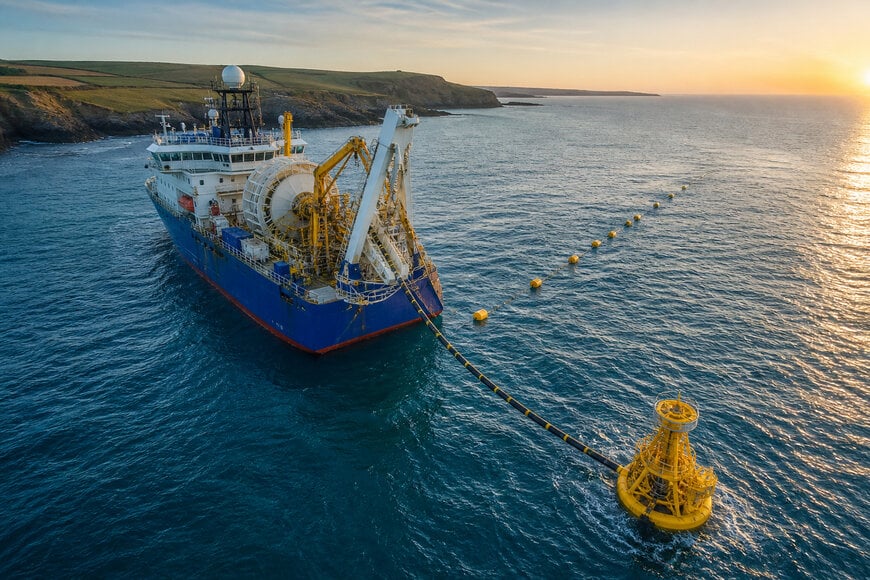
The interconnector spans approximately 575 km between Brittany in France and Cork in Ireland. A critical phase in the deployment involved the cable pull-in operation, connecting offshore cables to onshore infrastructure.
This operation was executed on the French side with the support of the cable-laying vessel Calypso, following initial installation works in Ireland. The pull-in marks a key step in integrating the subsea cable with land-based transmission systems.
The project involves coordinated manufacturing across multiple European facilities, ensuring consistent quality and supply chain efficiency for both submarine and terrestrial cable components.
Results: Increased Energy Exchange Capacity and System Resilience
Once completed, the interconnector will provide a 700 MW transmission capacity, enabling electricity exchange equivalent to the needs of approximately 450,000 homes.
From an operational perspective, the project enhances:
- Security of electricity supply through interconnection with the European grid
- Flexibility in balancing generation and demand across regions
- Integration of renewable energy sources by facilitating cross-border flows
The HVDC system also improves transmission efficiency over long distances, supporting stable and reliable energy transfer between France and Ireland.
Conclusion
The Celtic Interconnector demonstrates how advanced HVDC subsea cable systems can address structural challenges in modern energy networks. By enabling direct electricity exchange between Ireland and continental Europe, the project contributes to a more interconnected, resilient, and renewable-focused energy system.
Edited by an industrial journalist Sucithra Mani with AI assistance.
www.nexans.com
Conclusion
The Celtic Interconnector demonstrates how advanced HVDC subsea cable systems can address structural challenges in modern energy networks. By enabling direct electricity exchange between Ireland and continental Europe, the project contributes to a more interconnected, resilient, and renewable-focused energy system.
Edited by an industrial journalist Sucithra Mani with AI assistance.
www.nexans.com
